
A Little House, a Big Story: Dollhouses in Fashion
The final part of my account of Doll Dressing at The Museum at FIT brings us back to something familiar and comforting: the dollhouse. After surrealism, runway experiments, and broken dolls, this section invites us to slow down. To look closely at a tiny handbag, draw aside a little curtain, and imagine who might live in this miniature world.
But a dollhouse in this exhibition does not necessarily sit on a table. It can be carried as a handbag, spread across a coat, or translated into embroidery on a dress. A house becomes clothing, clothing becomes a space for play, and miniatures invite us to look more carefully.
What Makes a Miniature?
The curators begin with a simple but essential question: what exactly defines a miniature?
Not every small object is a miniature—a tiny insect, for instance, is simply small by nature. A miniature is a scaled-down replica of another object, defined by its recognizability: we must instantly see a dress, a handbag, or a house, not just a small item.
Creating a miniature is never a matter of mechanically shrinking every detail. Construction often needs simplification without sacrificing authenticity. Anyone who sews for dolls knows this challenge firsthand: standard seams become bulky, fasteners look oversized, and fabrics drape differently at reduced scale. Far from eliminating complexity, a smaller scale actually magnifies it.
The exhibition invites visitors to view these pieces first with the naked eye, then through a magnifying glass—first capturing the overall impression, then revealing the meticulous craftsmanship behind it.
Small Things Worth Looking At
This group of exhibits brought together objects from different decades and very different worlds.
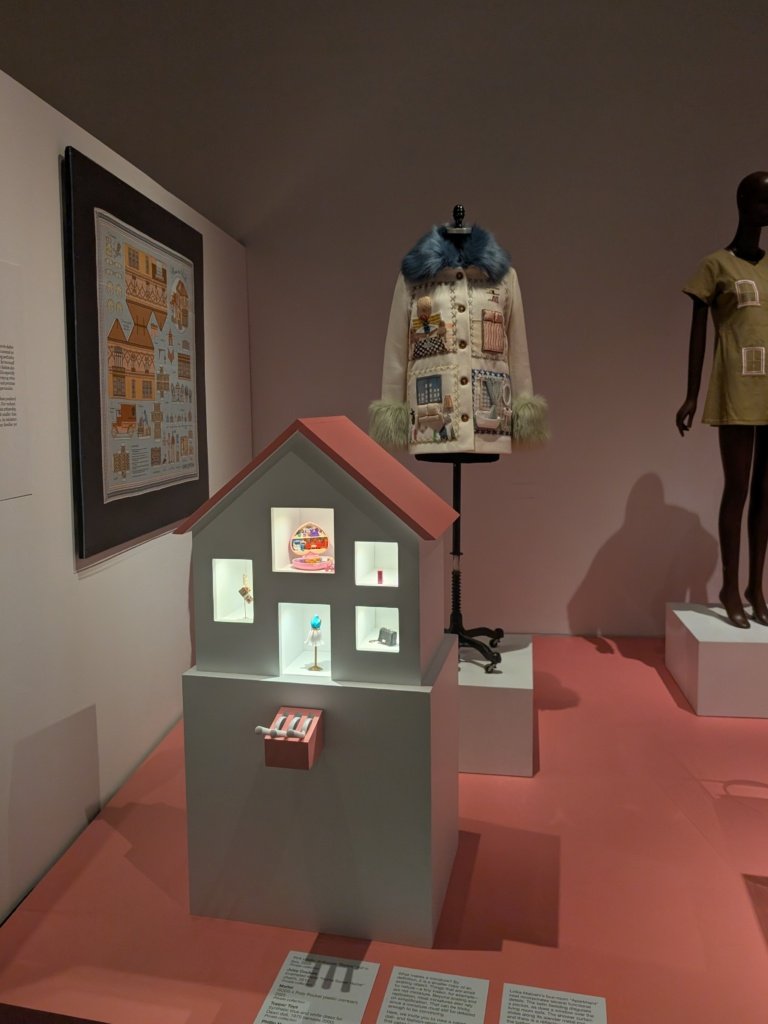
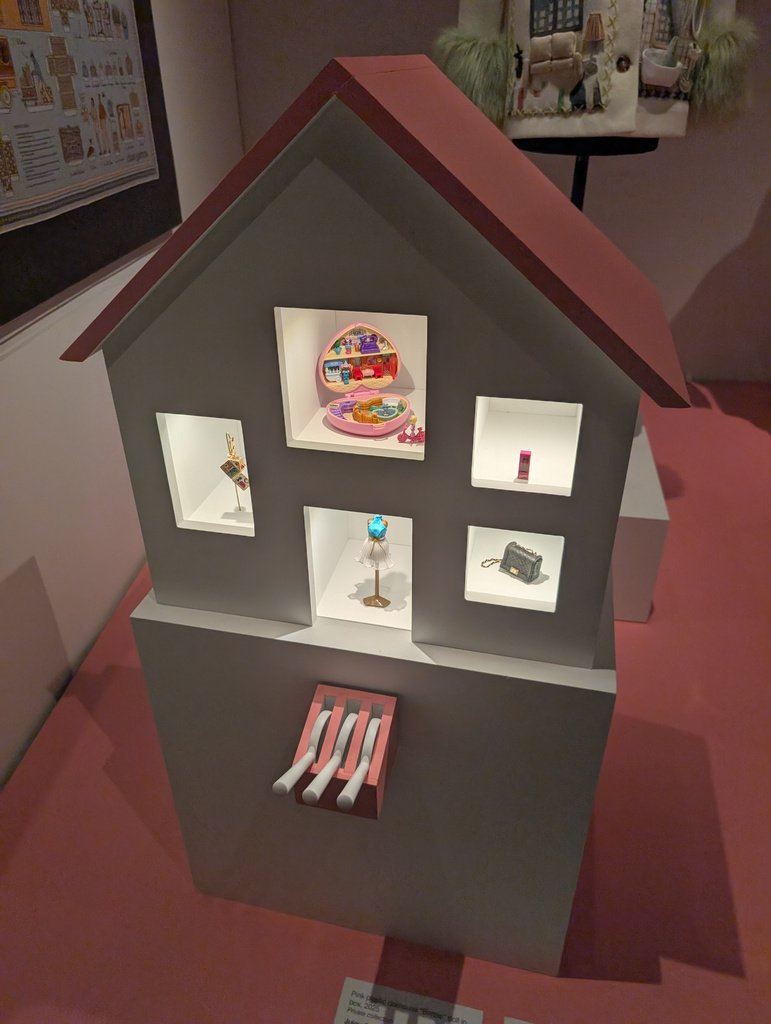
A pink plastic dollhouse with a boxed “Barbie” doll from 2025 appeared alongside Juicy Couture’s enameled metal Home Sweet Home charm from 2013. Nearby was Mattel’s plastic GCDS x Polly Pocket compact, also from 2025.
Even this small grouping showed how easily the dollhouse moves from the world of toys into the world of fashion accessories. A little house can be opened for play, or worn as a small expression of attachment to the idea of home.
Private collection
Other objects returned our attention directly to miniature wardrobes: a blue-and-white synthetic dress for Topper Toys’ Dawn doll, a 1970 design remade in 2000, and Phillip Nuveen’s miniature handbag in faux leather and metal, dated 2019.
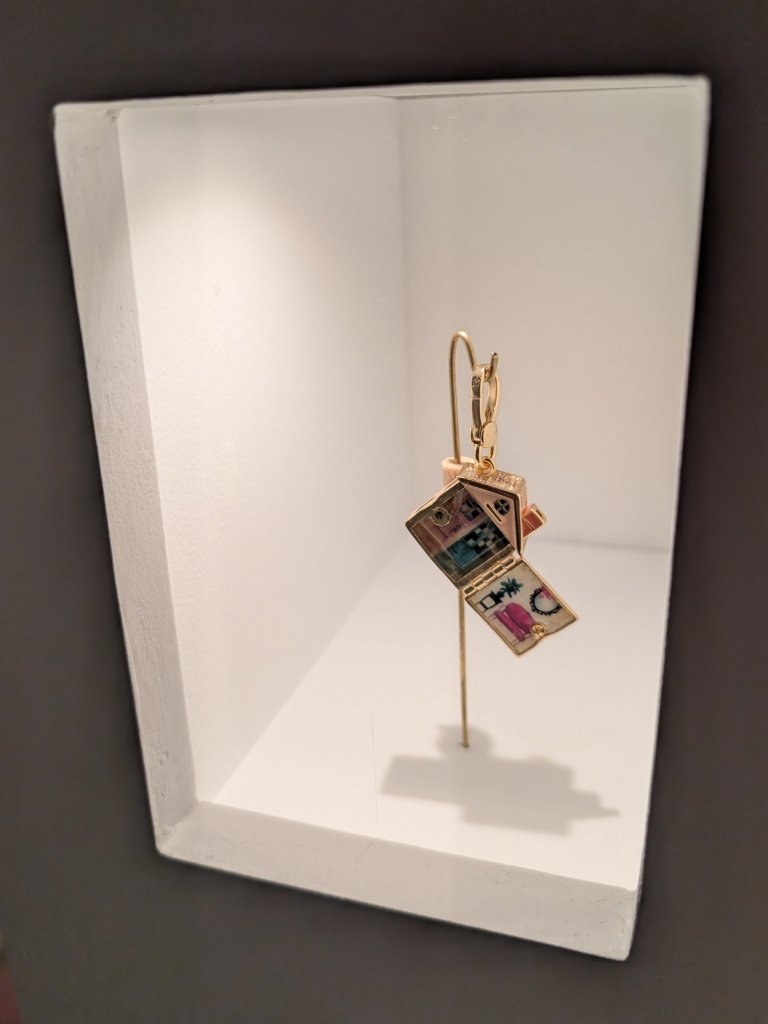
Enameled metal “Home Sweet Home”
charm, 2013
Private collection
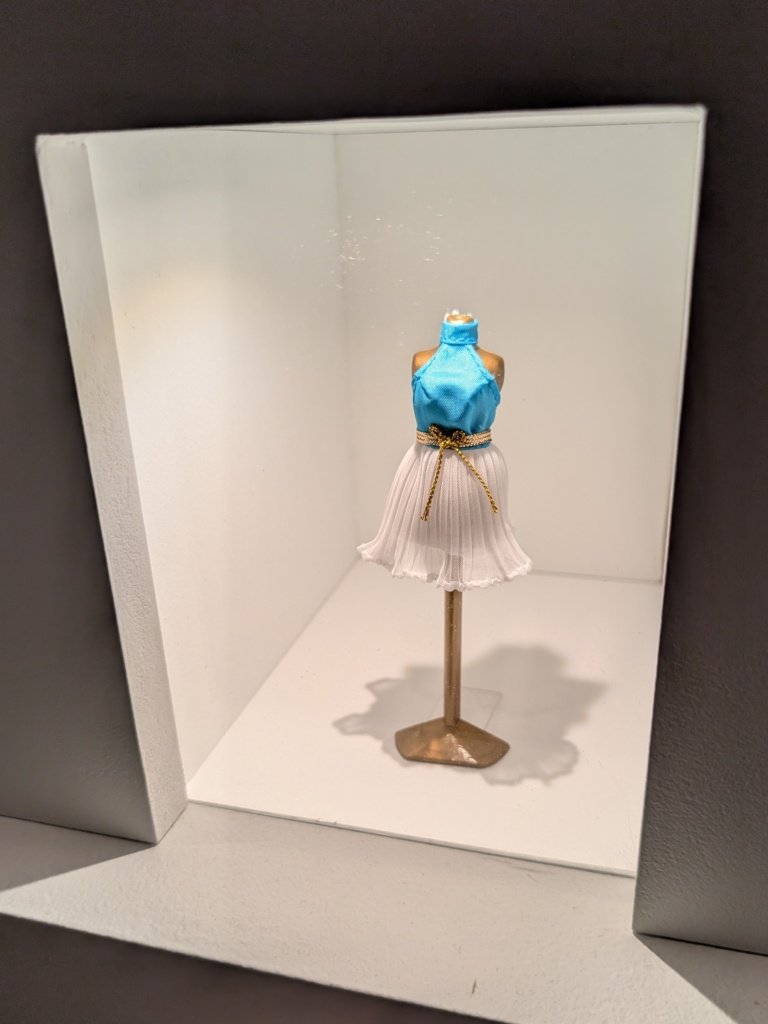
Synthetic blue and white dress for Dawn doll, 1970 (remade 2000)
Private collection
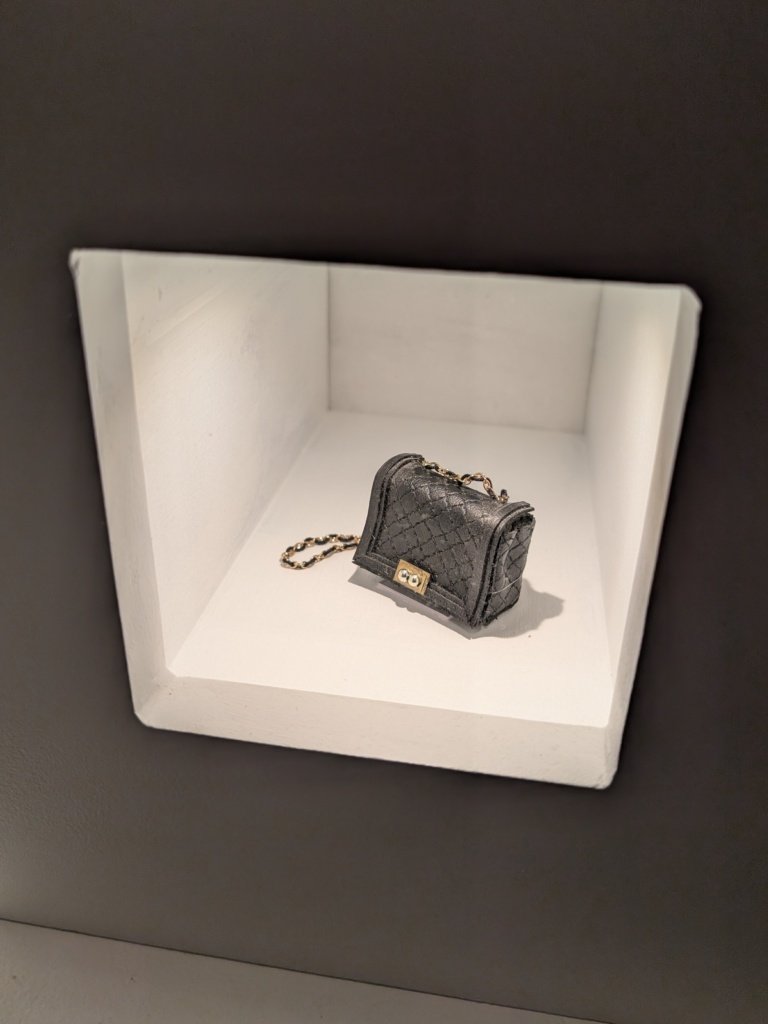
Faux leather and metal miniature handbag, 2019
Private collection
I particularly appreciated the invitation to examine these objects through a magnifying glass. At a small scale, it is easy to see only a “cute doll accessory” and overlook its construction. Yet that is often where the real craftsmanship lies: how a handle is formed, how materials are joined, and how the character of a full-size object survives in its tiny counterpart.
A Coat You Could Live In
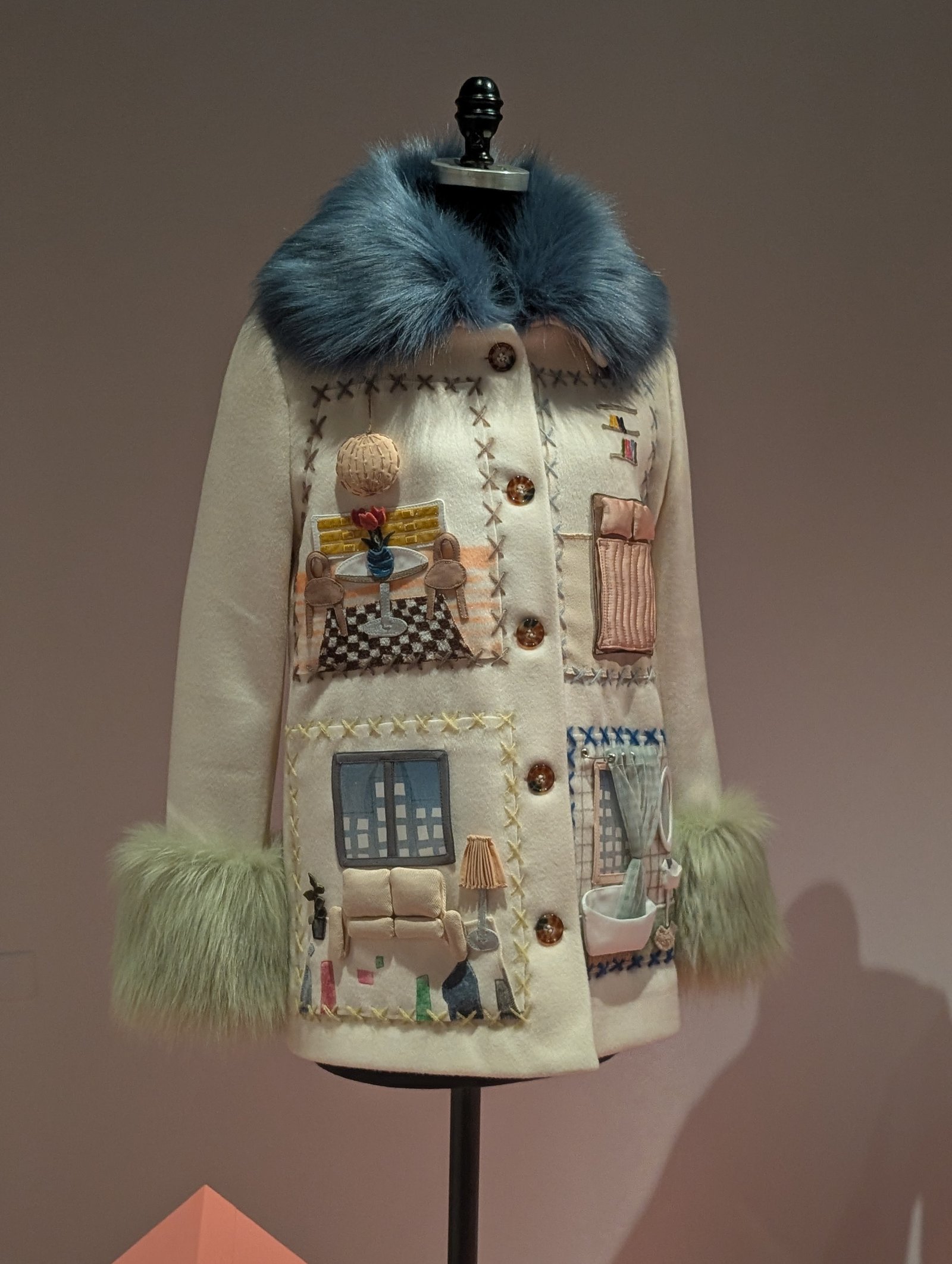
One of the most playful pieces in this section was Lirika Matoshi’s Apartment coat, presented under her label Lyrics by Matoshi. This 2024 design transforms the surface of a coat into a four-room apartment.
The off-white coat, with faux fur and appliqués, does more than illustrate an interior. It includes details that can actually be used and moved.
Satin bedding conceals a pocket. Another pocket is disguised as a window above the living-room sofa. The shower curtain slides along a slender metal rod, and a mirror above the bathroom sink really reflects.
This is not simply a decorative “dollhouse” theme. It is a little space that invites play: look inside, open something, slide something aside, and discover what is hidden underneath.
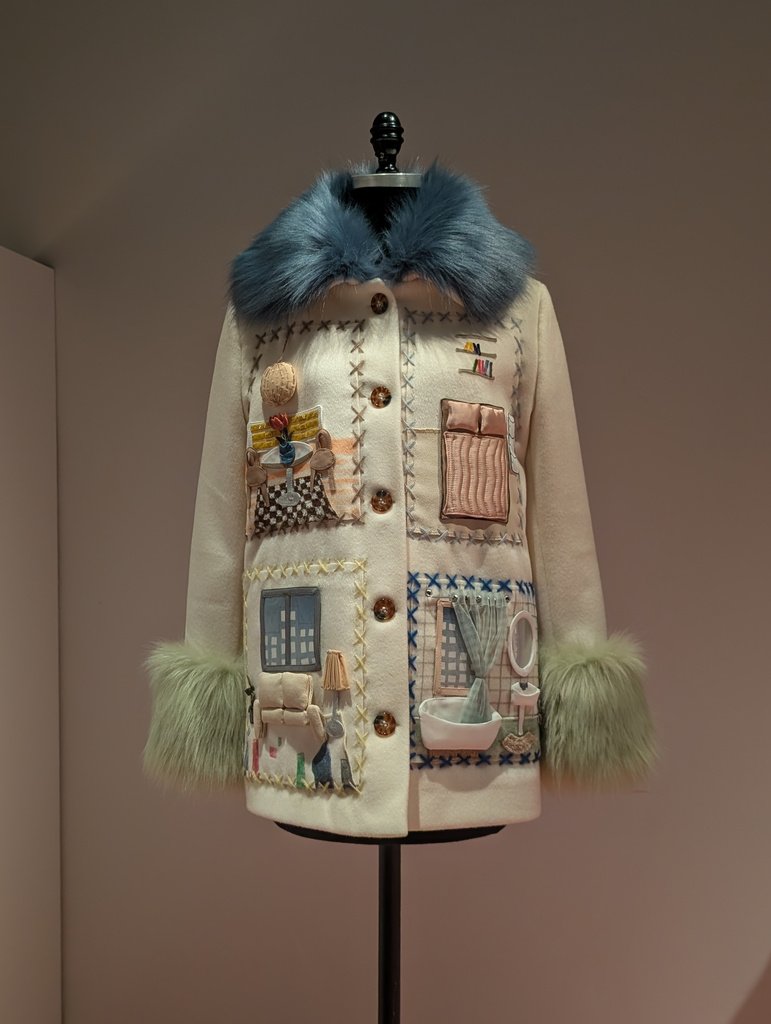
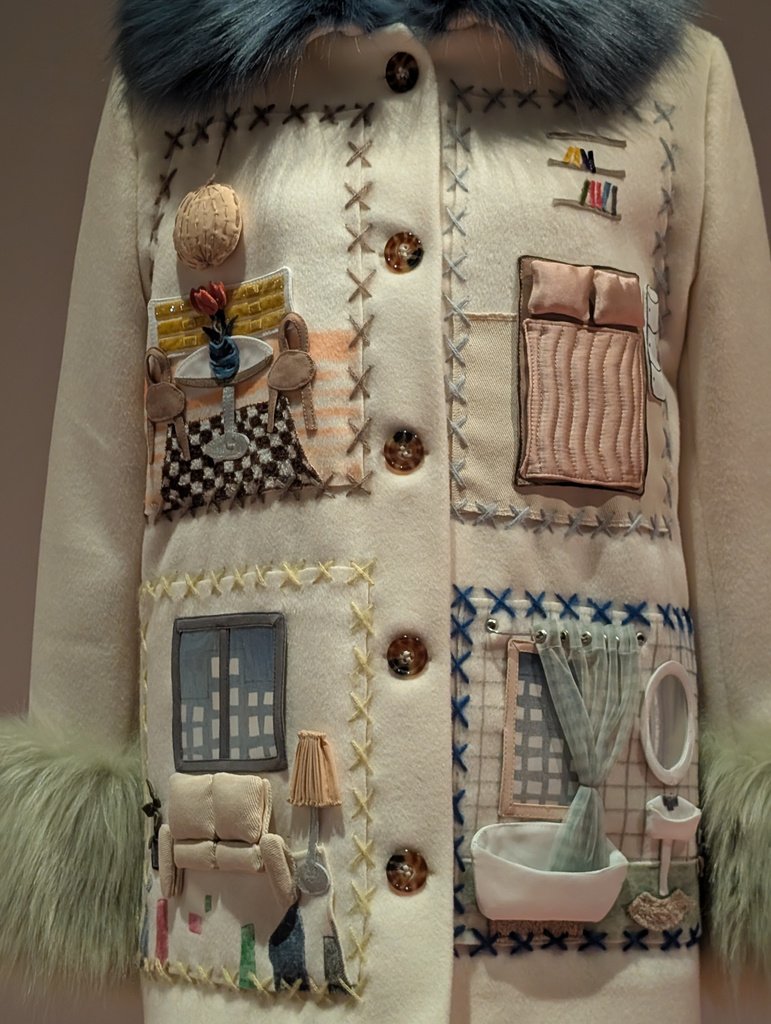
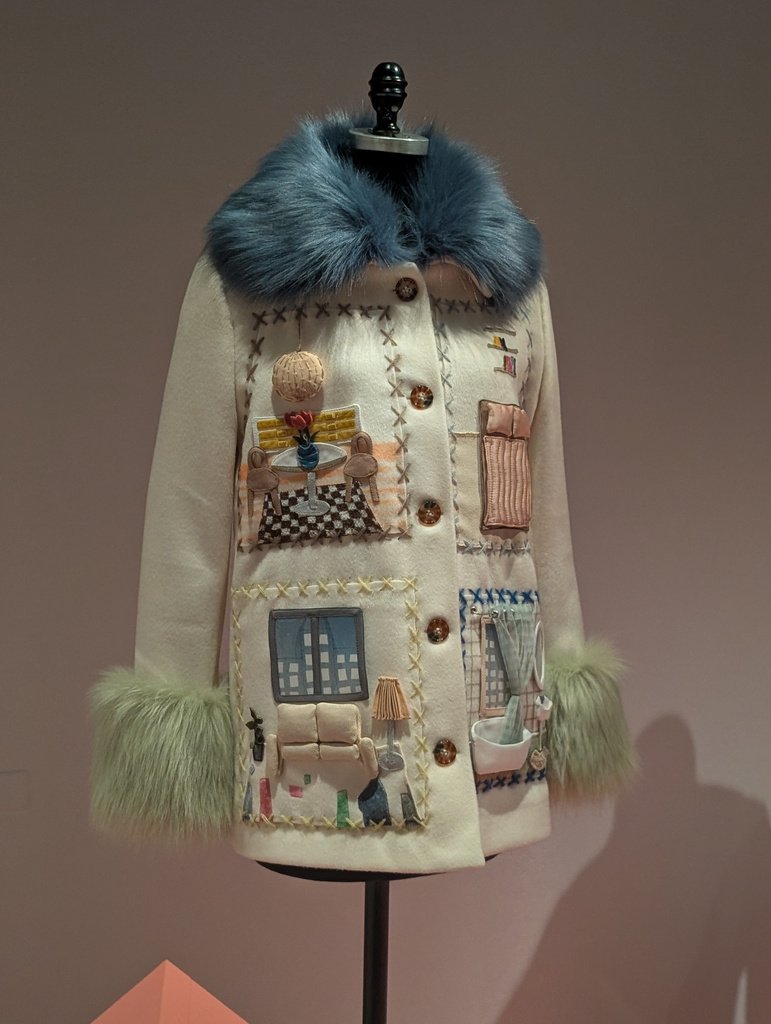
Off-white “Apartment” coat with faux fur and appliqués, 2024
MFIT, museum purchase
I love this dual purpose. The coat remains a garment with perfectly practical pockets, yet it also behaves like a toy. You want not merely to look at it, but to explore it with your hands: just as you would a real dollhouse.
Suddenly, the adult wardrobe becomes a little less serious. There is room in it for a tiny bathroom, satin bedding, and a curtain you can draw aside simply because it is delightful.
The Home We Carry
The Moschino house bag, made around 1991, offers another version of the same idea.
At first glance, it is a characteristic example of Franco Moschino’s playful approach to form: instead of an ordinary handbag, we have a multicolored leather house. Yet there is a logical connection behind the joke. Both a bag and a home conceal our belongings from the outside world, protect them, and define a small personal space.
Despite its unusual appearance, the bag is sturdy, roomy, and functional. Being a house does not prevent it from doing its job. Instead, it makes the familiar purpose of a handbag quite literally visible: we carry a little shelter for the things we need.
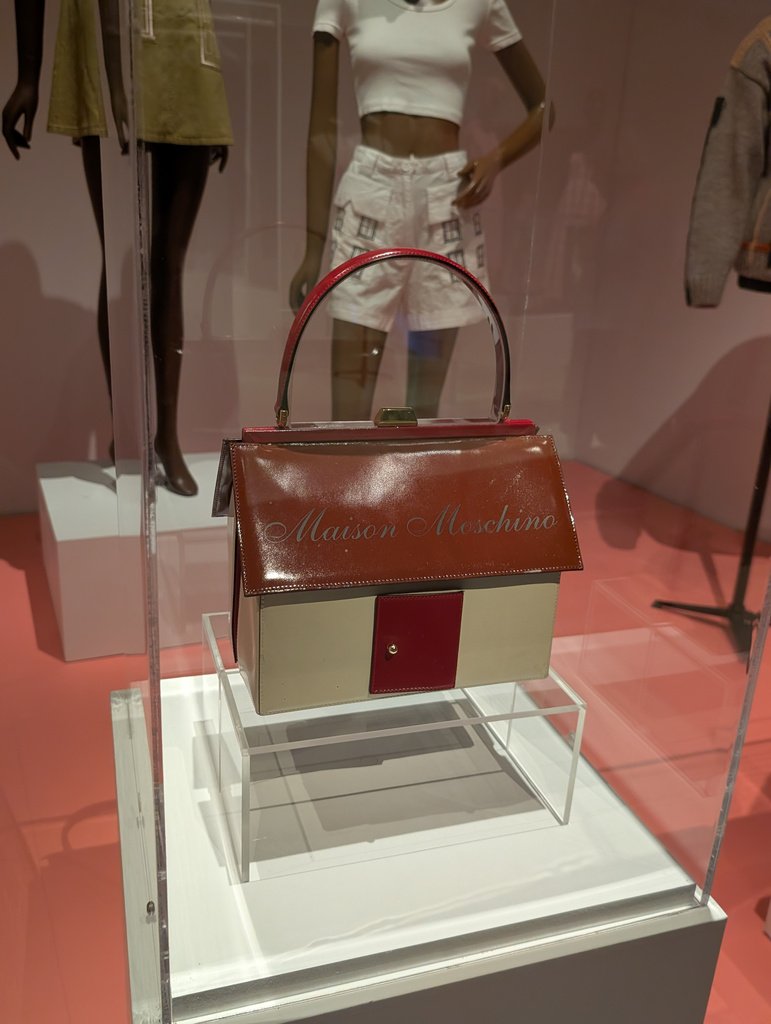
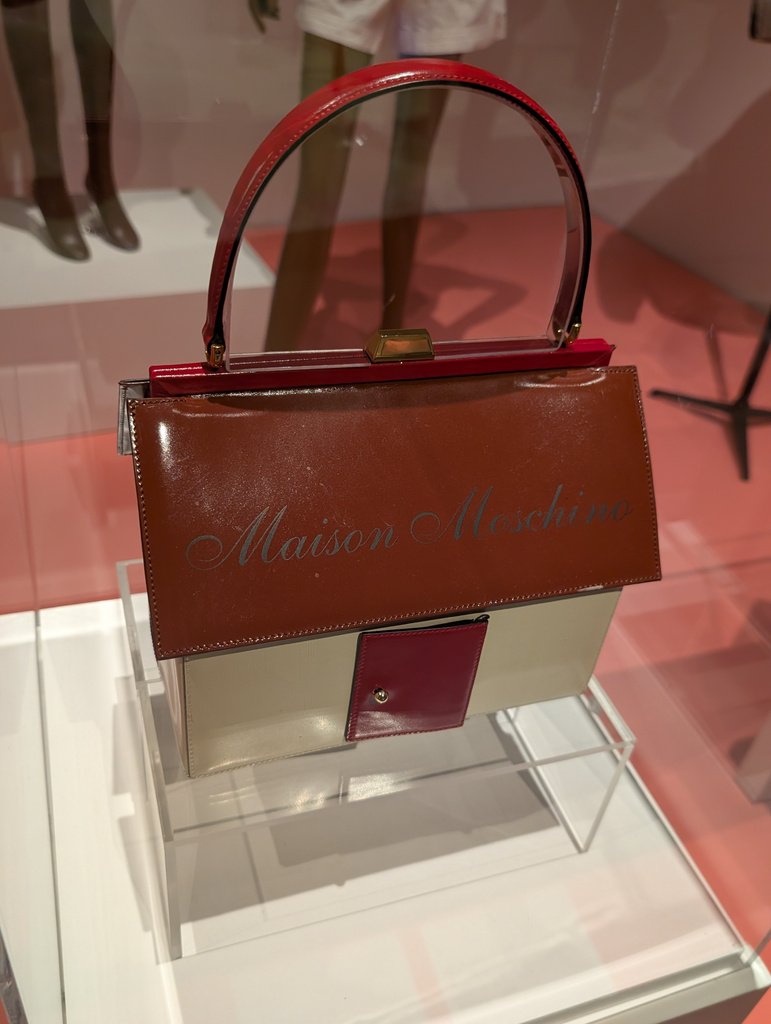
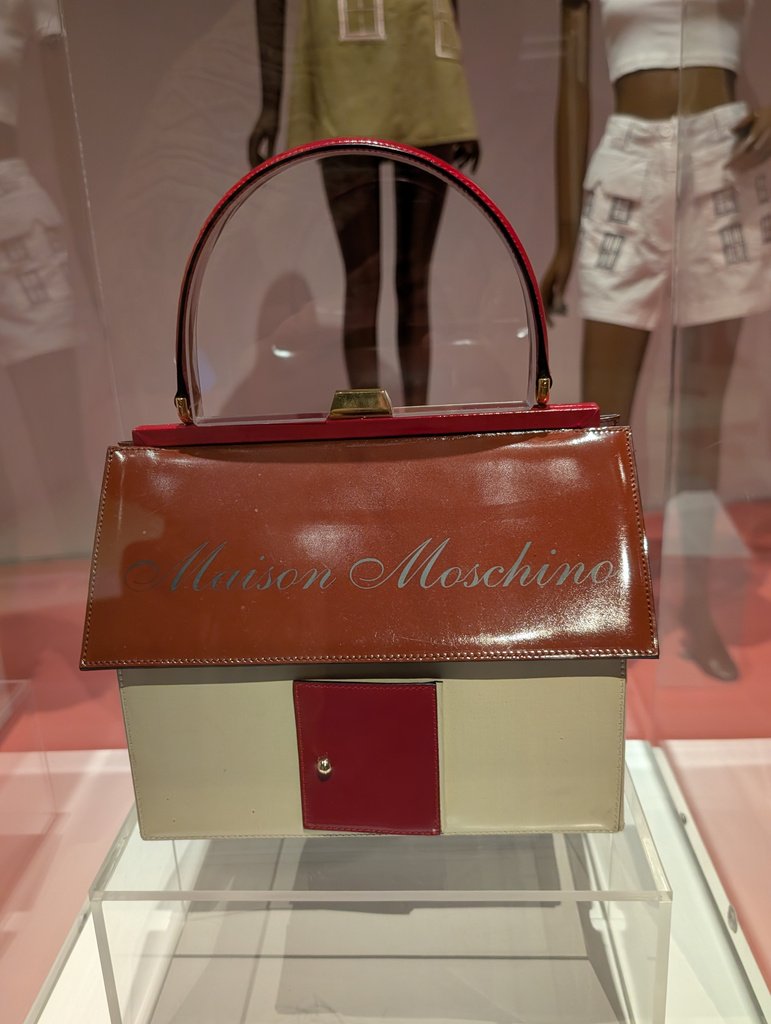
Multicolor leather “house” bag, circa 1991
Lent by The Gallery of Wearable Art
A more personal interpretation of home appears in Samantha Pleet’s A Lovely Haunting collection for spring 2016. The exhibition represented it with an embroidered tan cotton dress and white cotton shorts inspired by dollhouses.
The collection explored the idea of receiving messages from loved ones who have died. But this was not a frightening ghost story. Pleet spoke about that presence with warmth: “I don’t know why there would be horrible hauntings… I’m happily haunted.”
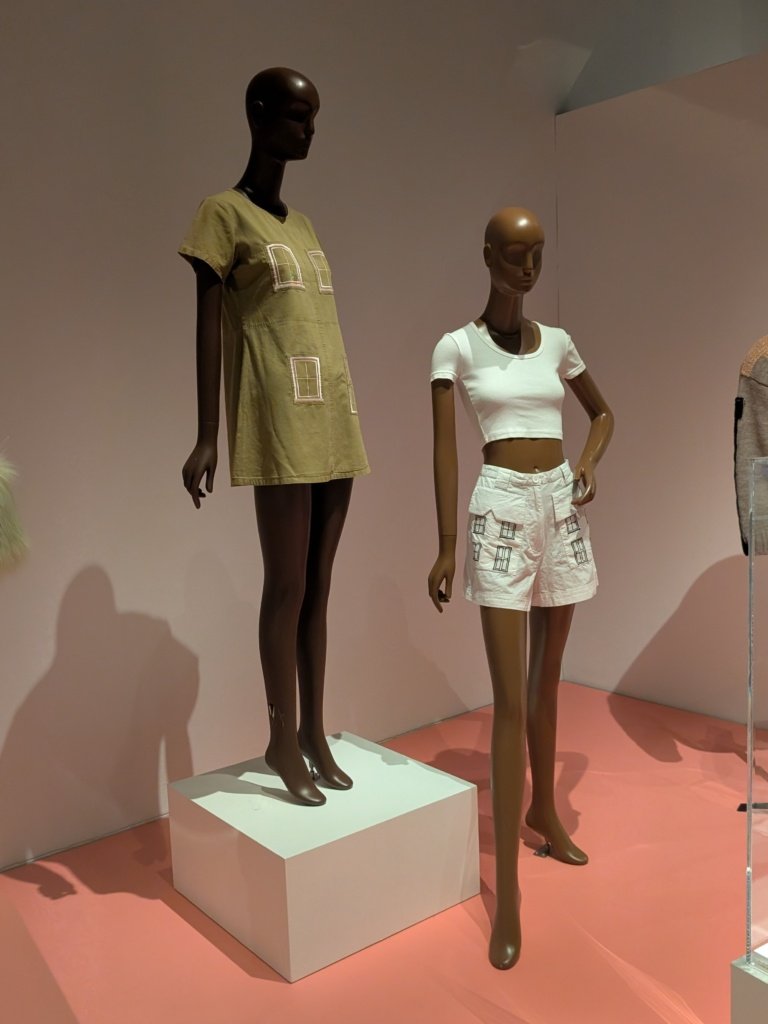
Embroidered tan cotton dress and white cotton shorts, spring 2016 A Lovely Haunting collection, Lent by Samantha Pleet
Alongside these pieces, she presented clothing printed to resemble the wallpaper in her grandmother’s home. Here, a house becomes much more than architecture. It becomes a memory of a person, a room, a familiar pattern that can still be recognized many years later.
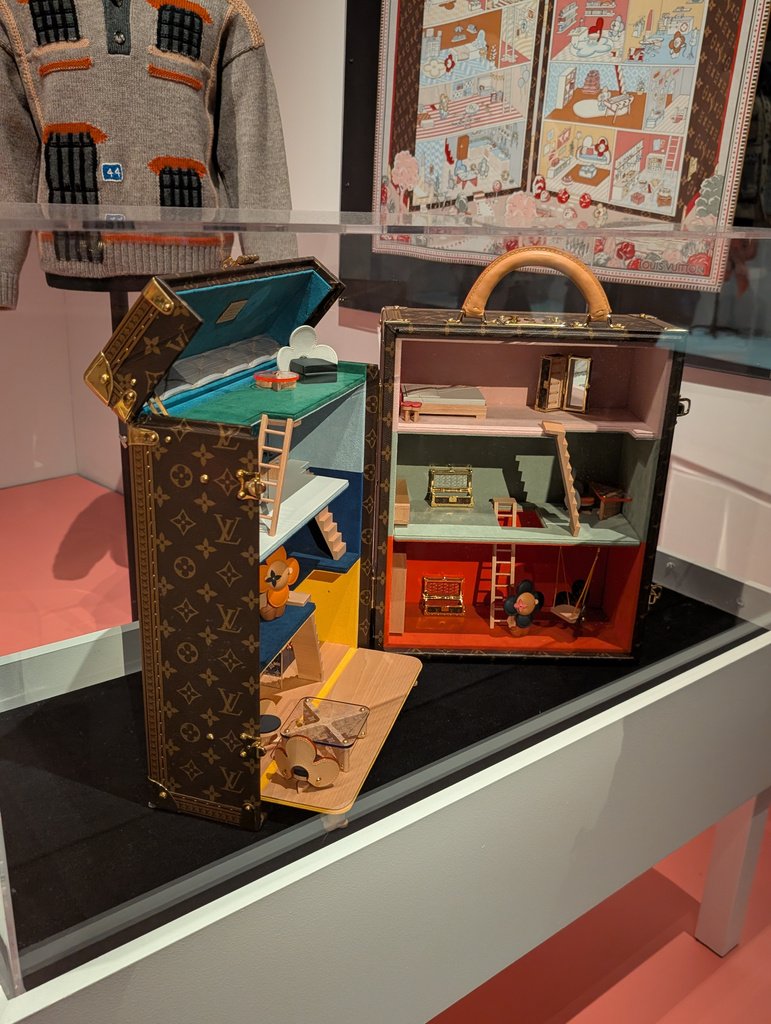
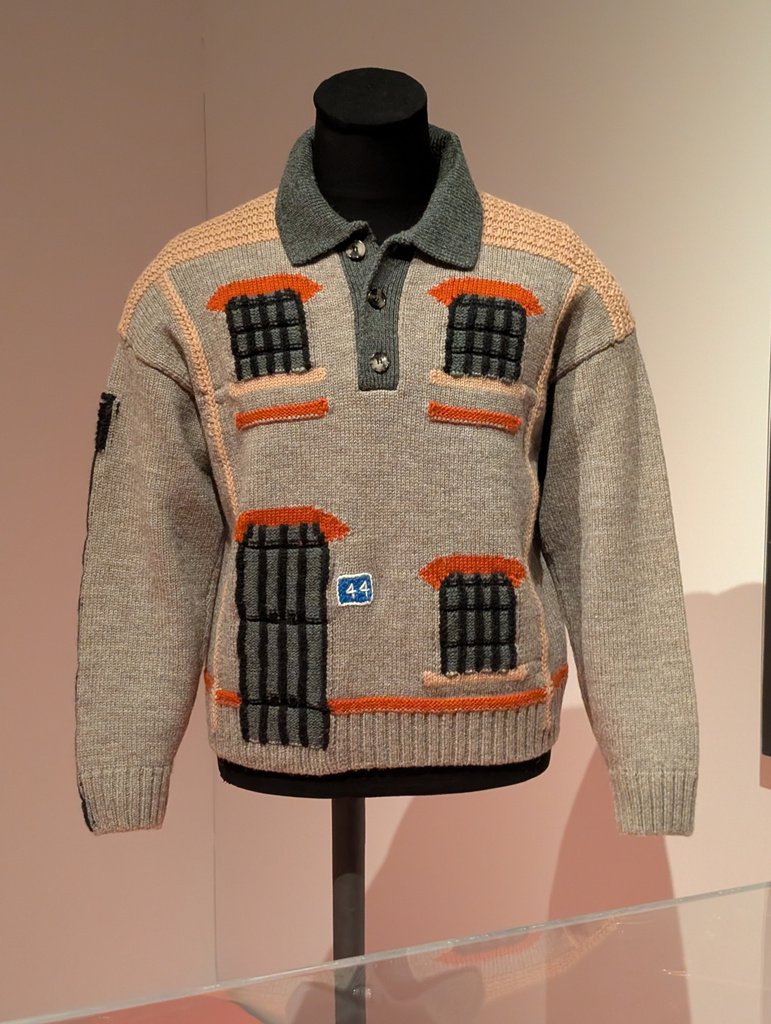
This is the note on which I would like to end my account of Doll Dressing. Behind all the runway looks, designer names, and museum dates are deeply personal things: the first dress we sewed for a doll, a favorite dollhouse, an old scrap of fabric, an object we cannot bring ourselves to throw away even though we grew up long ago.
Perhaps we love miniatures not simply because they are small and beautiful. They allow us to preserve an entire world, and make it small enough to keep close.
It is hard to imagine a better subject for the final article in this series. After all, a doll’s world is never just about the doll herself. It also includes everything we create around her: clothes, furniture, rooms, tiny possessions, and the stories that make a little life feel real.
Sources & Further Reading
Museum Exhibitions & Curatorial Frameworks
- The Museum at FIT (Fashion Institute of Technology): Doll Dressing exhibition, curated by Dr. Colleen Hill (examining scale, dollhouses, architecture in wearable art, and miniature material culture).
Designers, Fashion Houses & Wearable Art
- Lyrics by Matoshi (Lirika Matoshi): Apartment coat (2024) — An interactive garment constructed with faux fur, appliqués, functional pockets hidden in miniature furniture, working mirrors, and a sliding shower curtain.
- Moschino (Franco Moschino): Multicolored leather House Bag (c. 1991) — An iconic architectural handbag exploring themes of domesticity, privacy, and functional humor.
- Samantha Pleet: A Lovely Haunting collection (Spring 2016) — Dollhouse-inspired embroidered cotton garments and custom textiles featuring prints derived from ancestral wallpaper.
- Phillip Nuveen: Miniature faux leather and metal luxury handbag prototype (2019) — An exploration of artisan leather-working at a reduced scale.
Toys, Collectibles & Scale Pop Culture
- Mattel: Classic Barbie dolls and plastic dollhouses (2025 releases featured in exhibition context).
- Mattel x GCDS: GCDS x Polly Pocket compact (2025 collaboration) — High-fashion streetwear branding applied to nostalgic micro-scale toy design.
- Juicy Couture: Home Sweet Home enameled metal charm (2013) — A luxury accessory transforming the classic dollhouse archetype into a wearable trinket.
- Topper Toys: Dawn doll synthetic blue-and-white outfit (1970 original design, remade in 2000) — Historical study of 1:11 scale doll garments and synthetic textile manipulation.