
Modes in Miniature: When Dolls Become a Fashion Laboratory
The “Modes in Miniature” section of Doll Dressing at The Museum at FIT explores an idea familiar to every miniature tailor and collector: making doll clothes is never merely child’s play.
Miniature garments serve as sewing exercises, technical studies in cut and proportion, or serious prototypes. Here, dolls act as working tools, small-scale mannequins used to test drape, silhouette, and construction before full-size execution. The exhibition argues that dolls have shaped fashion just as much as fashion has shaped dolls.
Learning Fashion Through Dolls
Opening with an 1897 study by psychologists G. Stanley Hall and A. Caswell Ellis, the section highlights how children historically learned sewing, pattern-making, and color theory through dolls.
Dressing a doll makes fashion tangible. A tricky fastening or an oversized sleeve immediately demonstrates the difference between a design concept and a wearable garment. Working at a reduced scale also allows designers to experiment with complex ideas quickly and economically.
Doll clothes have long served both as practice for young makers and as evidence of professional skill.
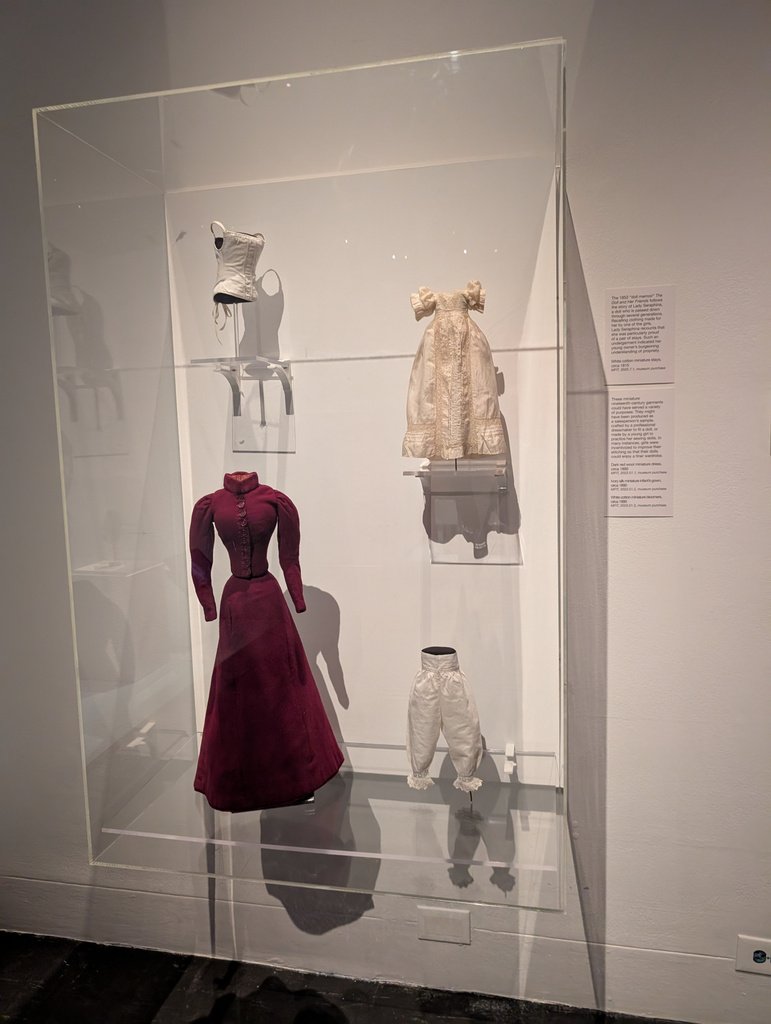
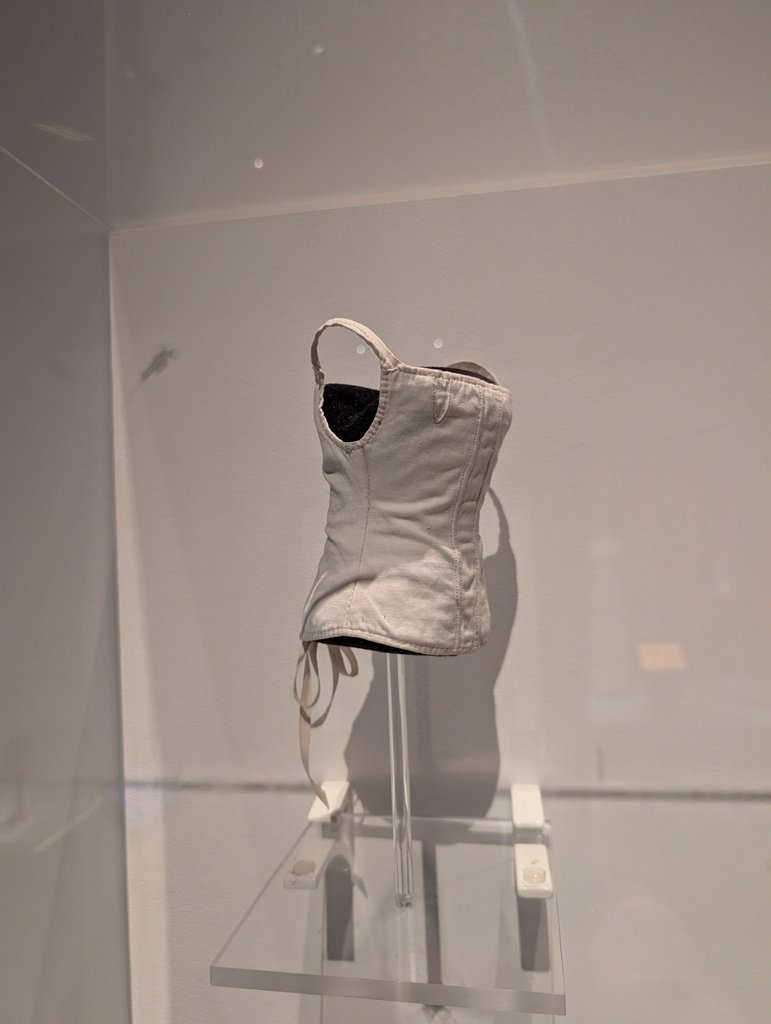
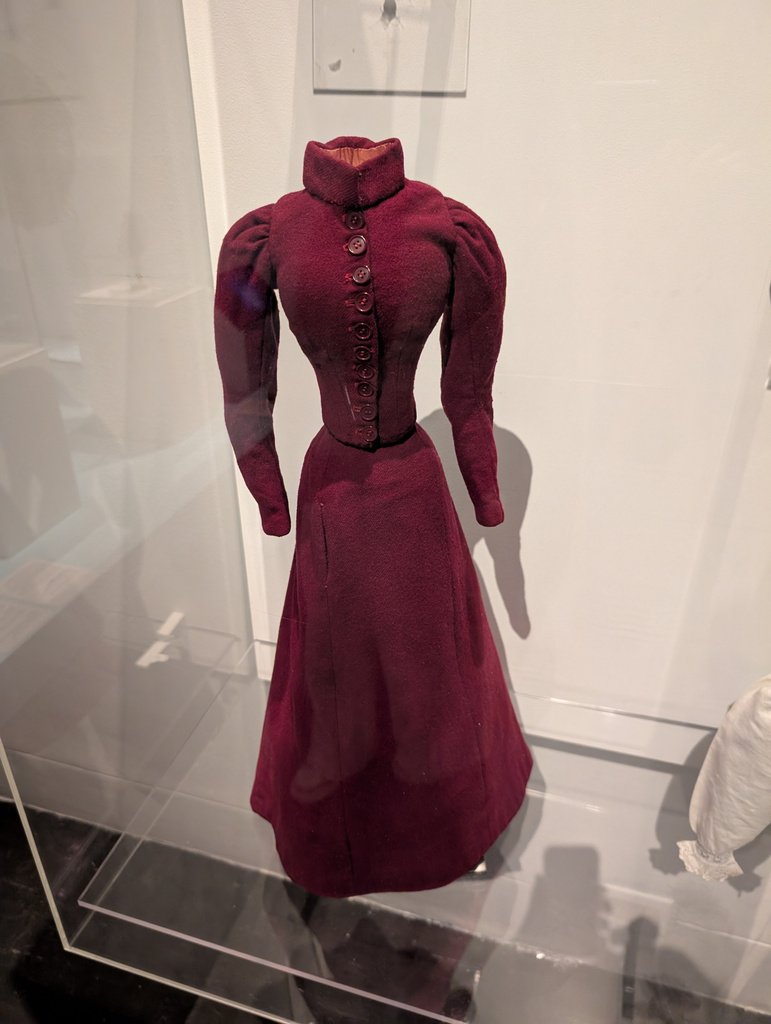
Doll clothes made by a young girl to practise sewing skills.
More expertly constructed miniature garments, used as salesperson’s samples.
Jeanne Lanvin: From Rag Dolls to Couture
One of the most touching stories in this section belonged to Jeanne Lanvin. Before she became one of the great Parisian couturières, she began her professional life by making and selling rag dolls.
Lanvin founded her fashion house in 1899, initially working as a milliner before expanding into couture. But dolls remained central to her world long after the fashion house became famous. She created doll clothes for the daughters of clients and at times displayed dolls in her boutique wearing miniature versions of Lanvin designs.
A 1924 photograph by Man Ray captured this wonderfully: a doll wears Lanvin’s “Columbine” dress while a model appears beside it in the full-size “Le Clou” dress. The pairing makes the miniature version much more than a charming accessory. It becomes a compact fashion statement, a three-dimensional advertisement, and a perfect expression of the Lanvin universe.
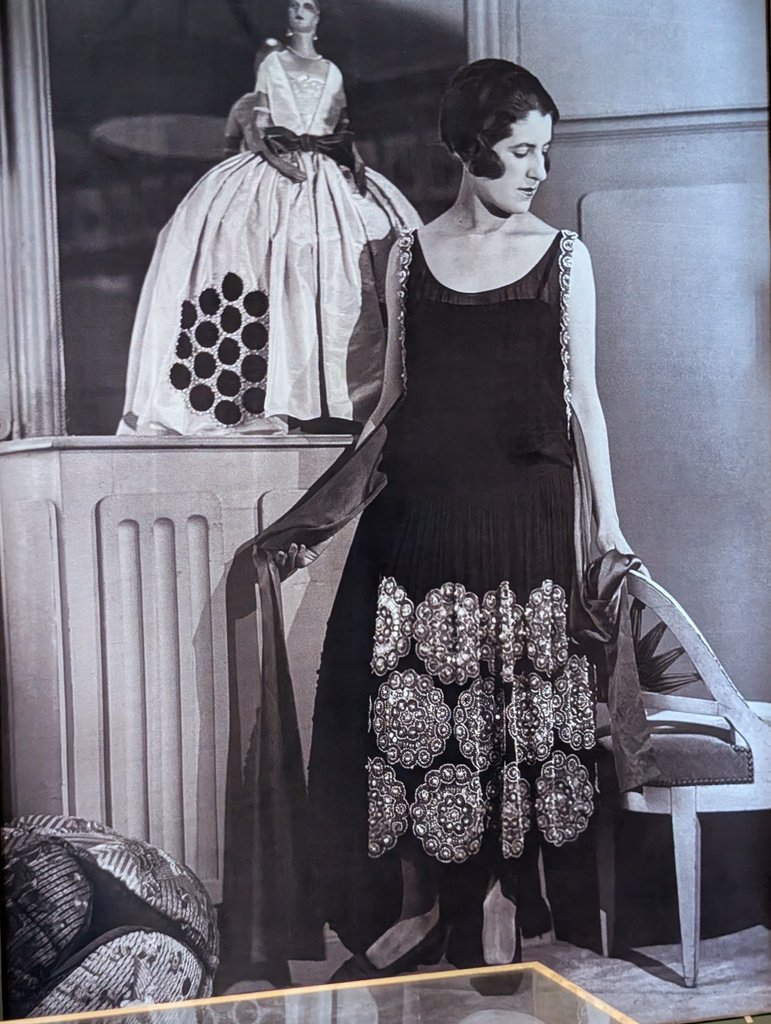
Jeanne Lanvin’s “Columbine” dress (on doll) and “Le Clou” dress (on model), 1924
Nearby, the exhibition showed a black beaded and embroidered taffeta evening dress by Lanvin, dating to about 1923. It is easy to imagine how a miniature interpretation would demand the same precision as the original: scale, surface, embroidery, silhouette, and the difficult question of how to preserve an adult gown’s elegance on a body only a fraction of the size.
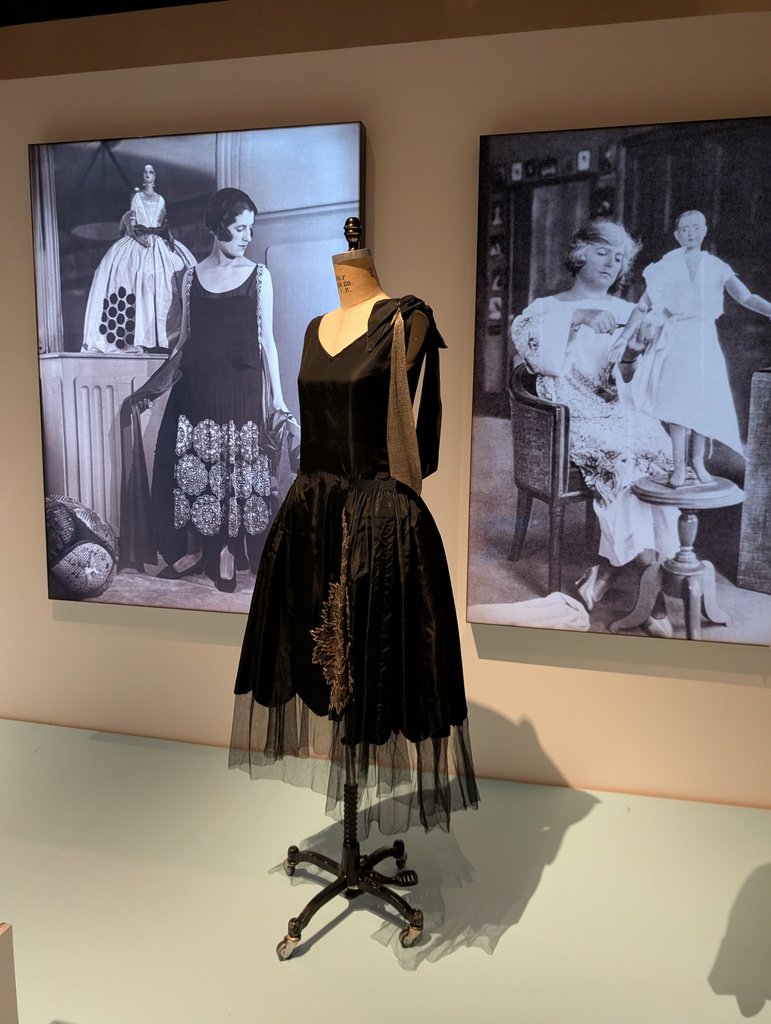
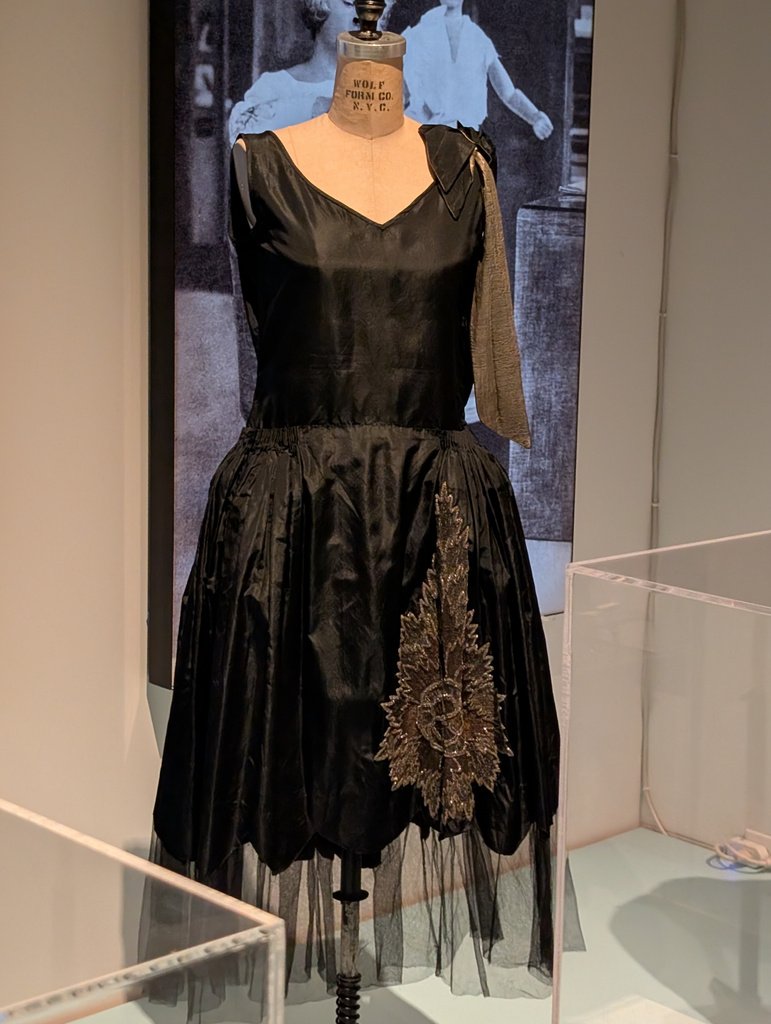
Black beaded and embroidered taffeta evening dress, circa 1923
MFIT, museum purchase
Alber Elbaz and Design for Hope
The Lanvin story continued into the twenty-first century with Alber Elbaz, who led the house from 2001 to 2015 and was himself a devoted doll lover.
Elbaz released several doll lines during his years at Lanvin. One of the most meaningful examples on display was a handmade cloth doll in a green silk dress, created in 2011 through a collaboration with Dessine l’Espoir, “Design for Hope.” The organization supports vulnerable communities, particularly in Africa, through creative and income-generating projects.
The dolls and their miniature garments were made by Swazi women living with and affected by HIV/AIDS, using designs inspired by Elbaz’s work. This was an especially moving reminder that doll clothes can carry much more than fashion fantasy, makers working far beyond Paris.
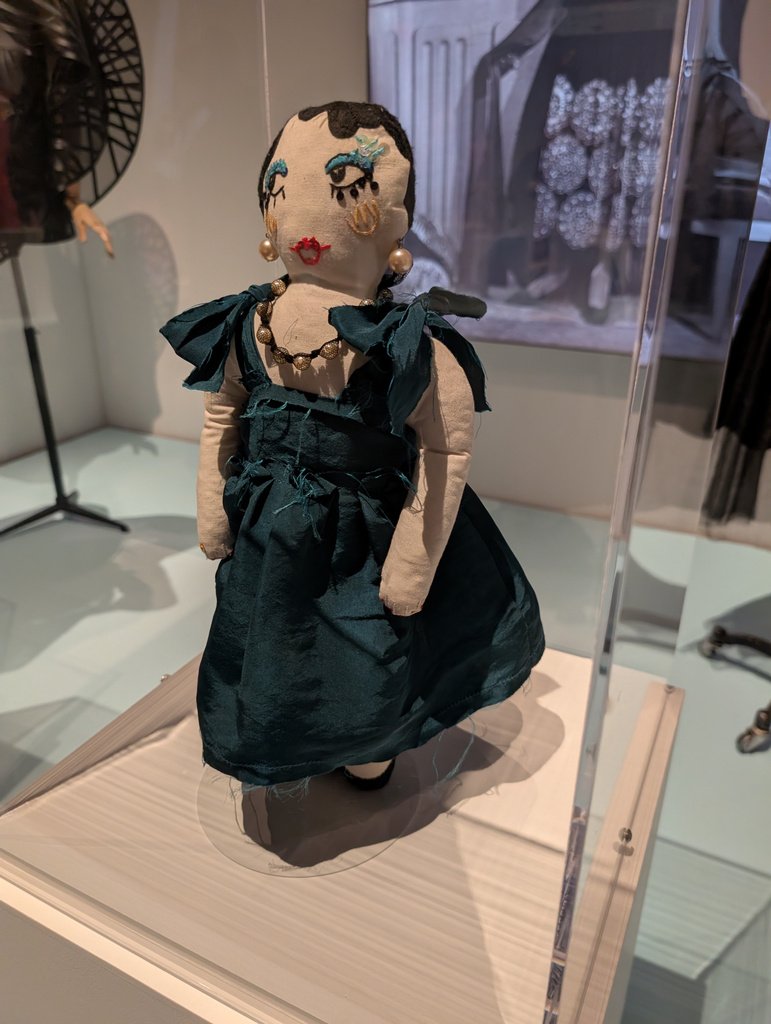
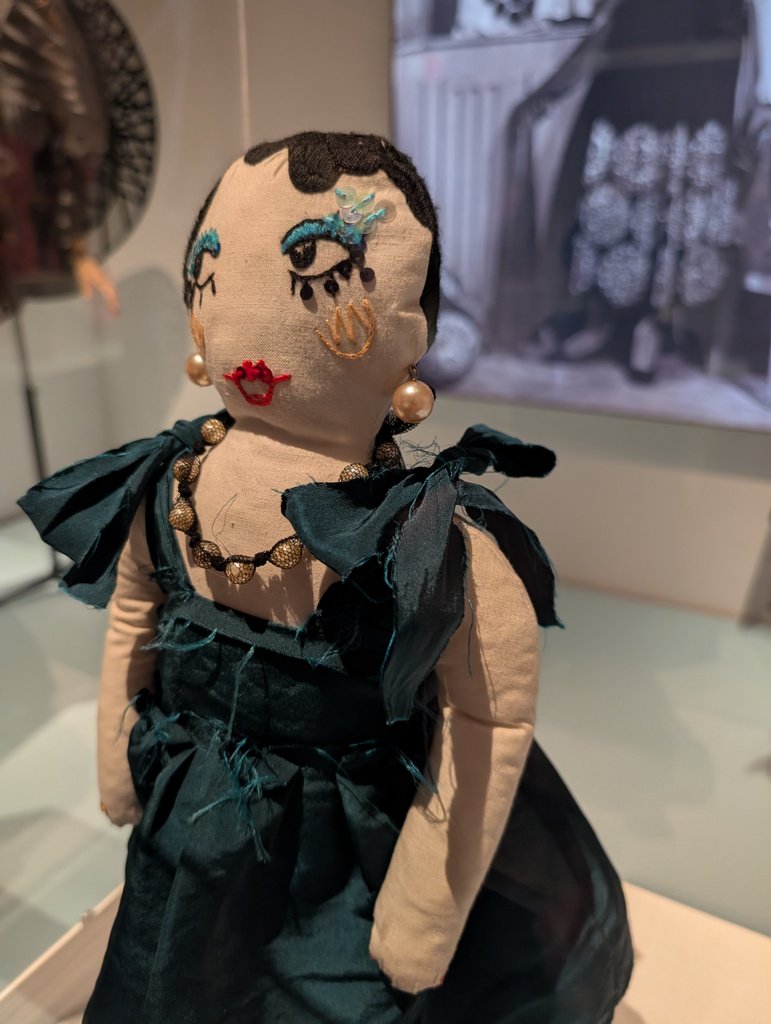
Handmade cloth doll in green silk dress, 2011
Lent by The Gallery of Wearable Art
The doll’s green silk dress is not simply a scaled-down Lanvin reference. It is evidence of hands, knowledge, and a collaborative project in which fashion became a means of dignity and survival.
Vionnet’s Two-Foot Mannequin
Another highlight was Madeleine Vionnet, whose working method sounds astonishingly familiar to anyone who has ever draped fabric on a doll body.
Vionnet did not learn to sketch. Instead, she developed designs directly in fabric on a wooden mannequin measuring only two feet tall. At this reduced scale, she could control the cloth more easily and experiment with difficult drapery before translating an idea into a full-size garment.
A 1923 photograph by Thérèse Bonney shows Vionnet at work with her miniature mannequin. Seen beside her off-white silk-satin negligee from 1929, the photograph reveals that miniature forms were not decorative novelties in her practice. They were serious instruments of invention.
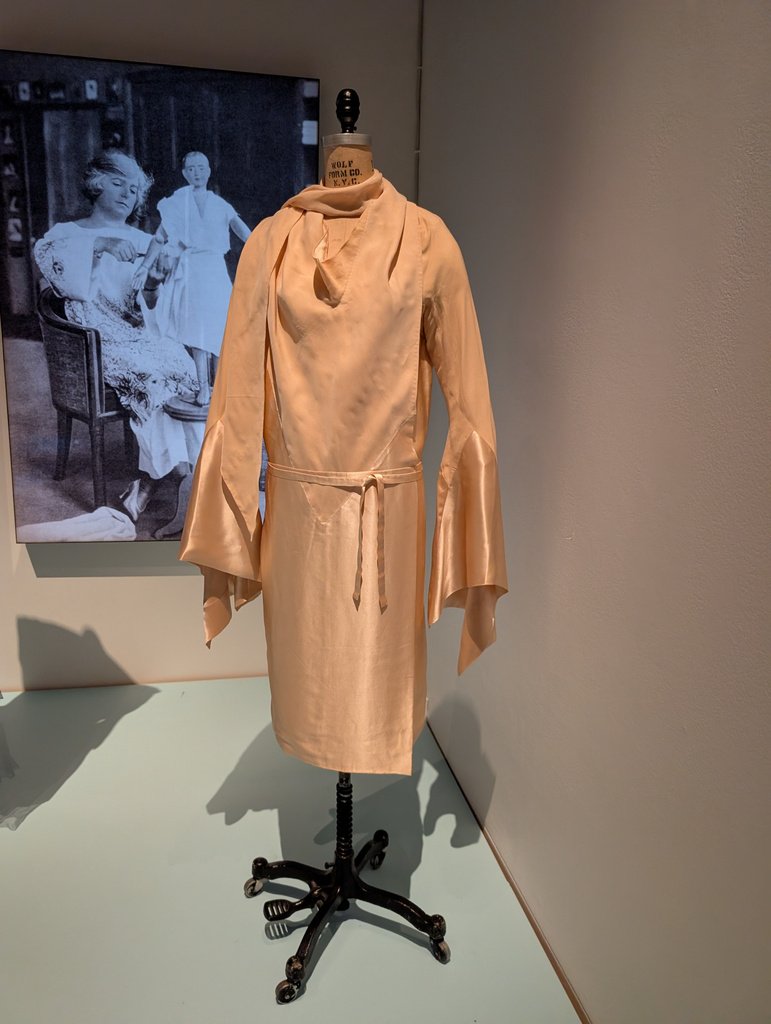
Madeleine Vionnet draping on a miniature mannequin, 1923
The Regents of the University of California, The Bancroft Library, University of California, Berkeley
Vionnet
Off-white silk satin negligee, 1929 MFIT,museum purchase
This is perhaps the section’s most satisfying lesson for doll makers: working small is not “lesser” work. It can be an extraordinarily precise way to study a garment. Miniature scale concentrates every challenge. Grain direction, bias, balance, drape, proportion, and seam placement become impossible to ignore.
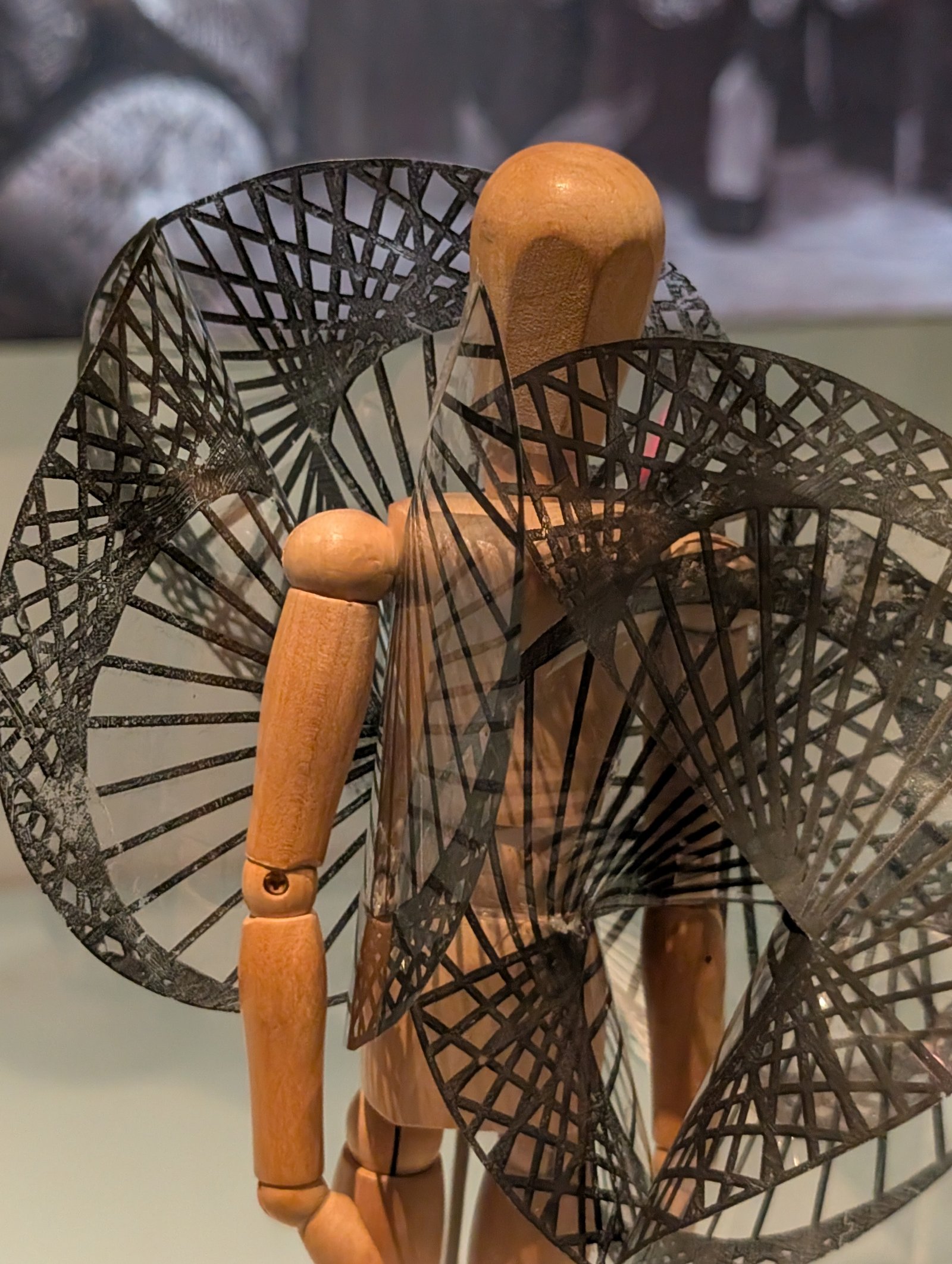
ThreeASFOUR: From Dummy to 3D Print
The final part of the section moved from early twentieth-century couture to digital fashion. The New York design trio threeASFOUR: Gabi Asfour, Angela Donhauser, and Adi Gil, were represented by a 3D-printed ensemble, doll, and video from their fall 2022 Ancestors couture collection.
Their process began with a small artist’s dummy. From that miniature figure, the designers developed their ideas into a virtual couture collection and then into full-size, 3D-printed garments.
Design trio threeASFOUR bridged this tradition with modern tech in their Fall 2022 Ancestors collection:
- Small Artist’s Dummy: Testing initial form, silhouette, and concept.
- Digital Model: Refining structure and technical details virtually.
- 3D-Printed Garment: Producing the final wearable couture look.
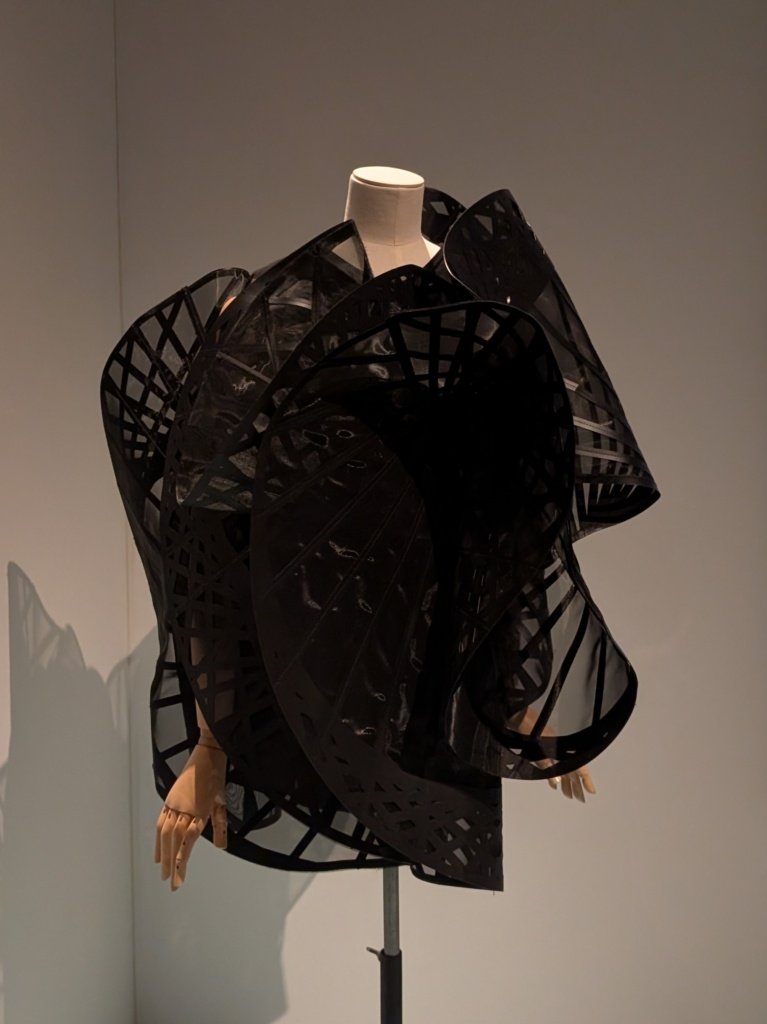
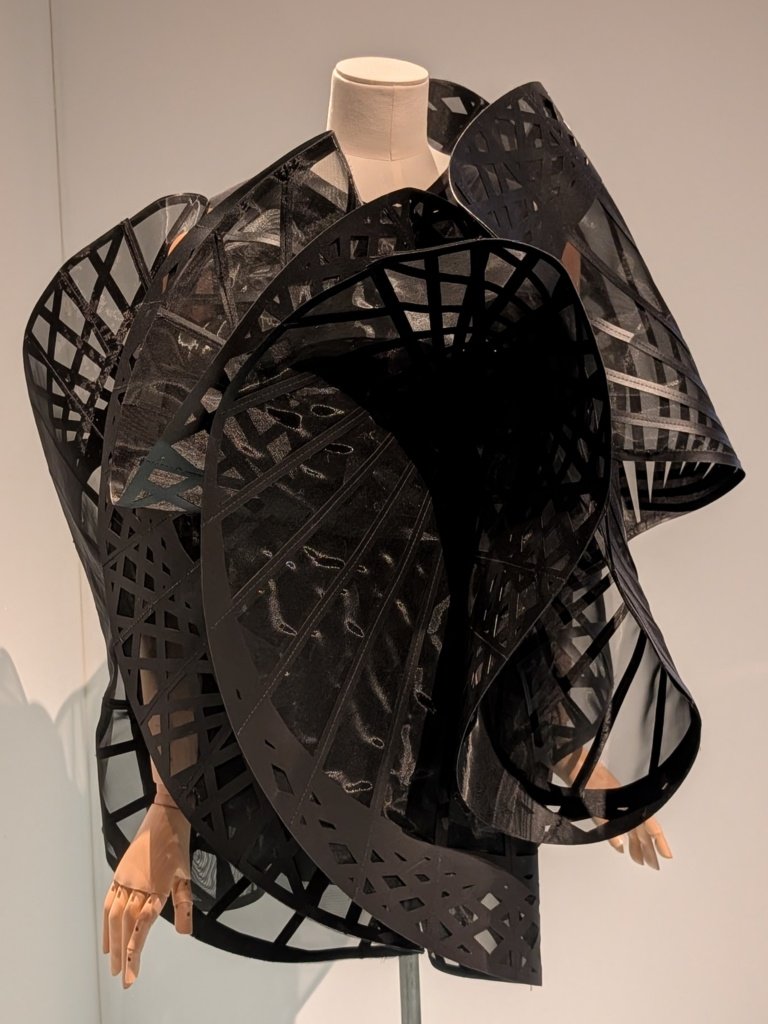
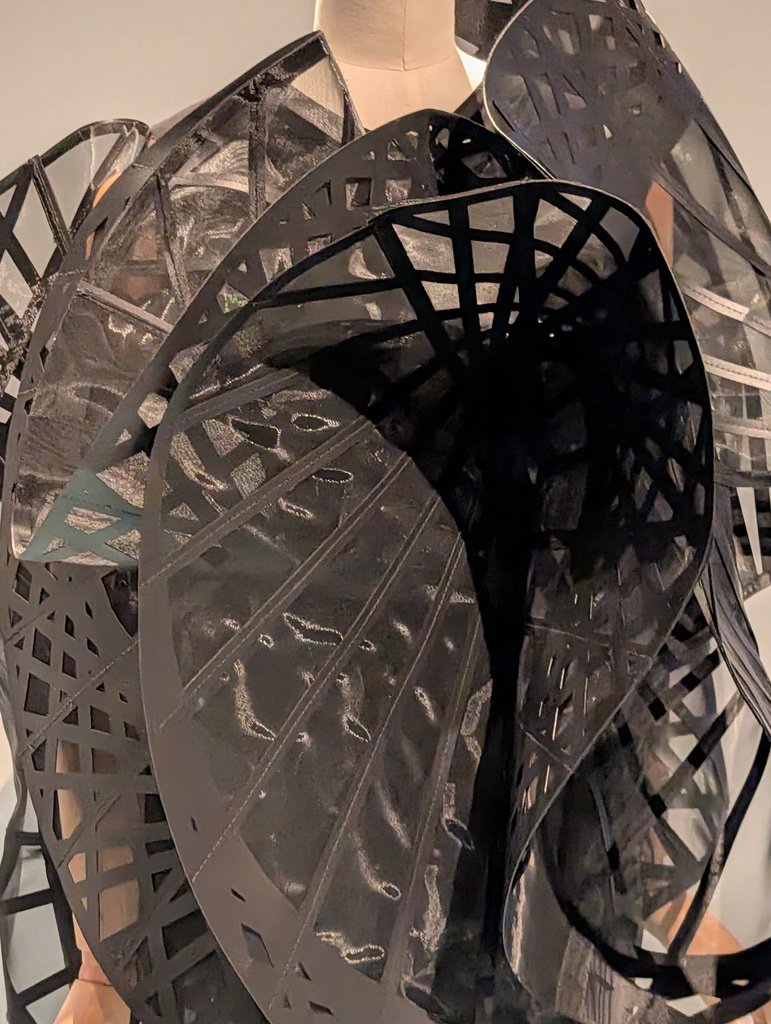
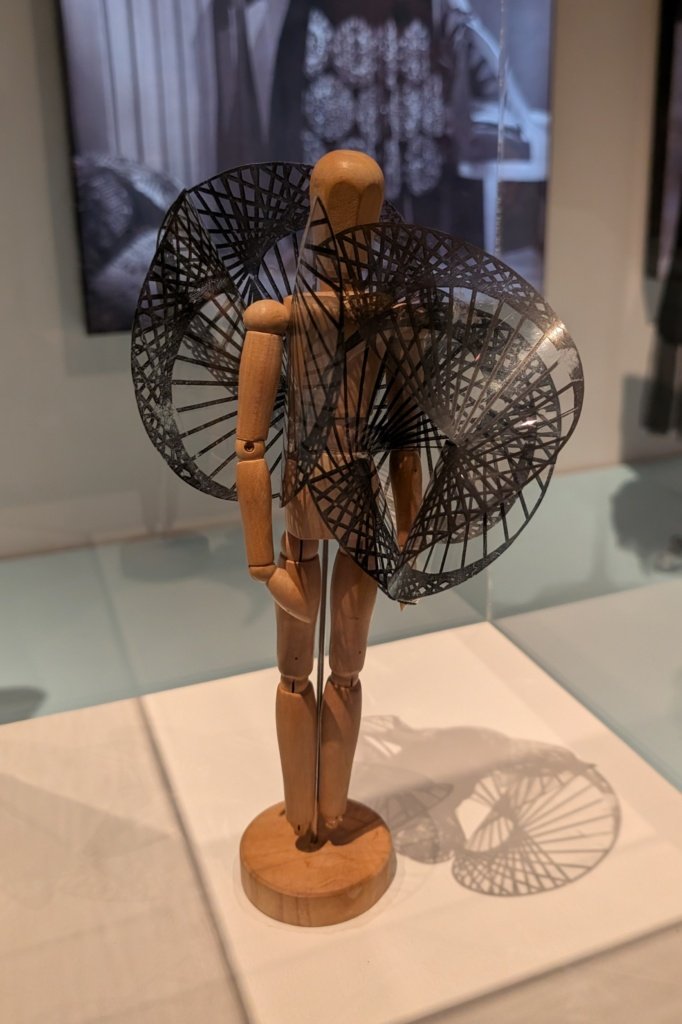
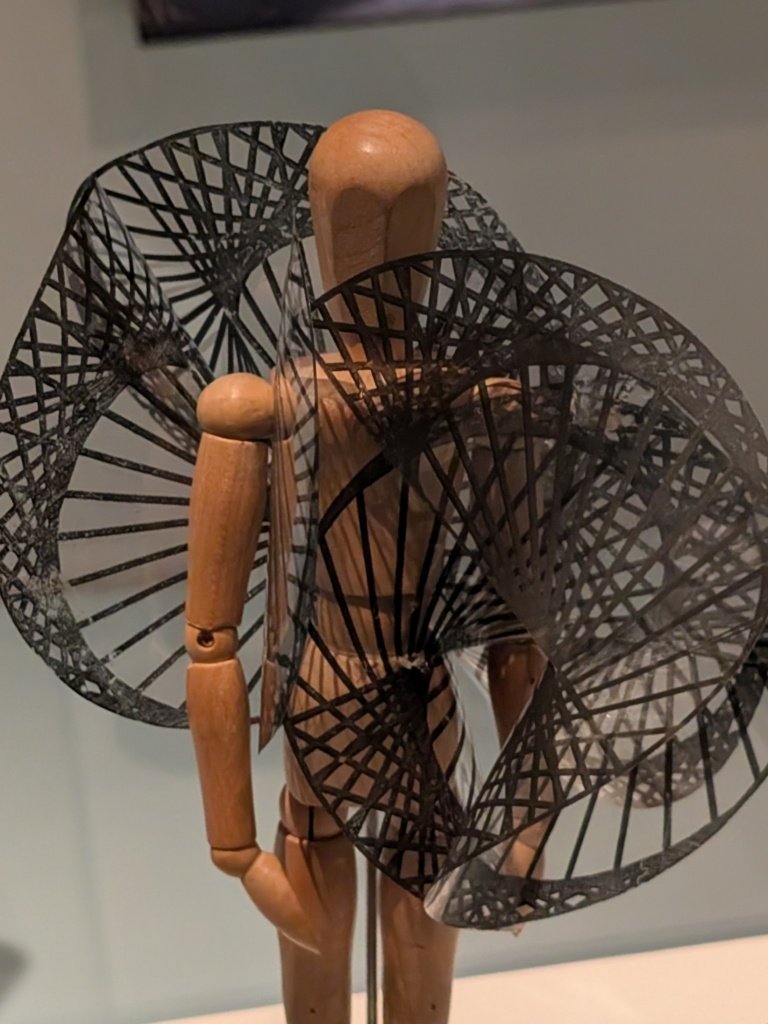
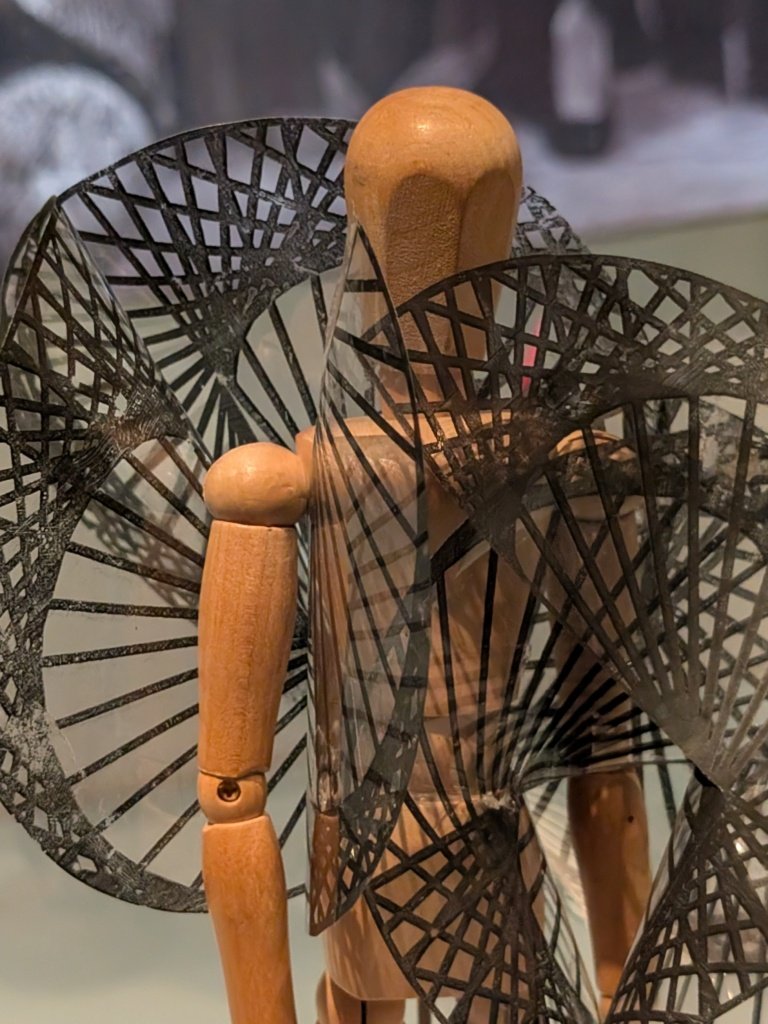
3D-printed ensemble, doll, and video, fall 2022 Ancestors couture collection Lent by threeASFOUR
This contemporary example brought the gallery’s larger story into focus. From a child sewing a doll dress, to Madeleine Vionnet draping on a two-foot mannequin, to threeASFOUR using digital design and 3D printing, the miniature body remains a place where fashion ideas can begin.
Periods of disruption have often made this approach even more necessary. Wartime restrictions limited materials and production, while the COVID-19 pandemic pushed many designers toward miniature presentations, dolls, models, and digital alternatives when conventional runway production became difficult or impossible. The exhibition’s Modes in Miniature section culminates in pairings of full-scale runway looks and miniature versions by designers including Bode, Anna Sui, and Jason Wu.
Whether forced by wartime material shortages, pandemic restrictions, or digital evolution, designers continually return to the miniature body as a launching pad for big ideas.
The underlying point fits perfectly with Modes in Miniature: doll clothes have long served both as practice for young makers and as evidence of professional skill. However, because the photographed text is incomplete and scrambled, I would not include the Lady Seraphina material in the main article as a definite quotation or fully identified object unless you can check the label again.
What is already clear is that this section was one of the exhibition’s most affectionate tributes to miniature dressmaking. It recognized doll clothes as memory, play, technical training, couture research, professional experimentation, and, at their finest, a complete fashion world in miniature.
Sources & Further Reading
Exhibition & Museum Resources
- The Museum at FIT (Fashion Institute of Technology): Doll Dressing exhibition, curated by Dr. Colleen Hill (exploring the historical interplay between dolls, doll dressmaking, and high fashion).
- Thérèse Bonney & Man Ray: Historical fashion photography archives capturing early 20th-century couture ateliers (specifically Man Ray’s 1924 photographs of Lanvin designs and Thérèse Bonney’s 1923 photographs of Madeleine Vionnet at work).
Historical Studies & Literature
- G. Stanley Hall & A. Caswell Ellis (1897): A Study of Dolls — A landmark psychological study examining how children learn motor skills, sewing, garment construction, and design principles through play with dolls.
- Anonymous / Historical Fiction (1912): The Story of Lady Seraphina — A doll’s fictional memoir detailing historical garment construction, young girls learning to sew, and 18th/19th-century miniature stays and clothing.
Designers, Collections & Social Projects
- Jeanne Lanvin Archives: Early history of House of Lanvin (1899–1920s), focusing on Lanvin’s origins in millinery, rag dolls, and miniature couture garments.
- Madeleine Vionnet & Bias Cut Innovation: Technical documentation on Vionnet’s draping methodology using her signature two-foot wooden mannequin.
- Alber Elbaz x Dessine l’Espoir (2011): “Design for Hope” initiative — A collaborative project producing handmade cloth dolls dressed in Lanvin designs to support HIV/AIDS-affected women in Eswatini (Swaziland).
- threeASFOUR (Fall 2022 Couture Collection): Ancestors — Modern digital couture workflows bridging physical artist dummies, 3D modeling software, and additive 3D garment printing.