
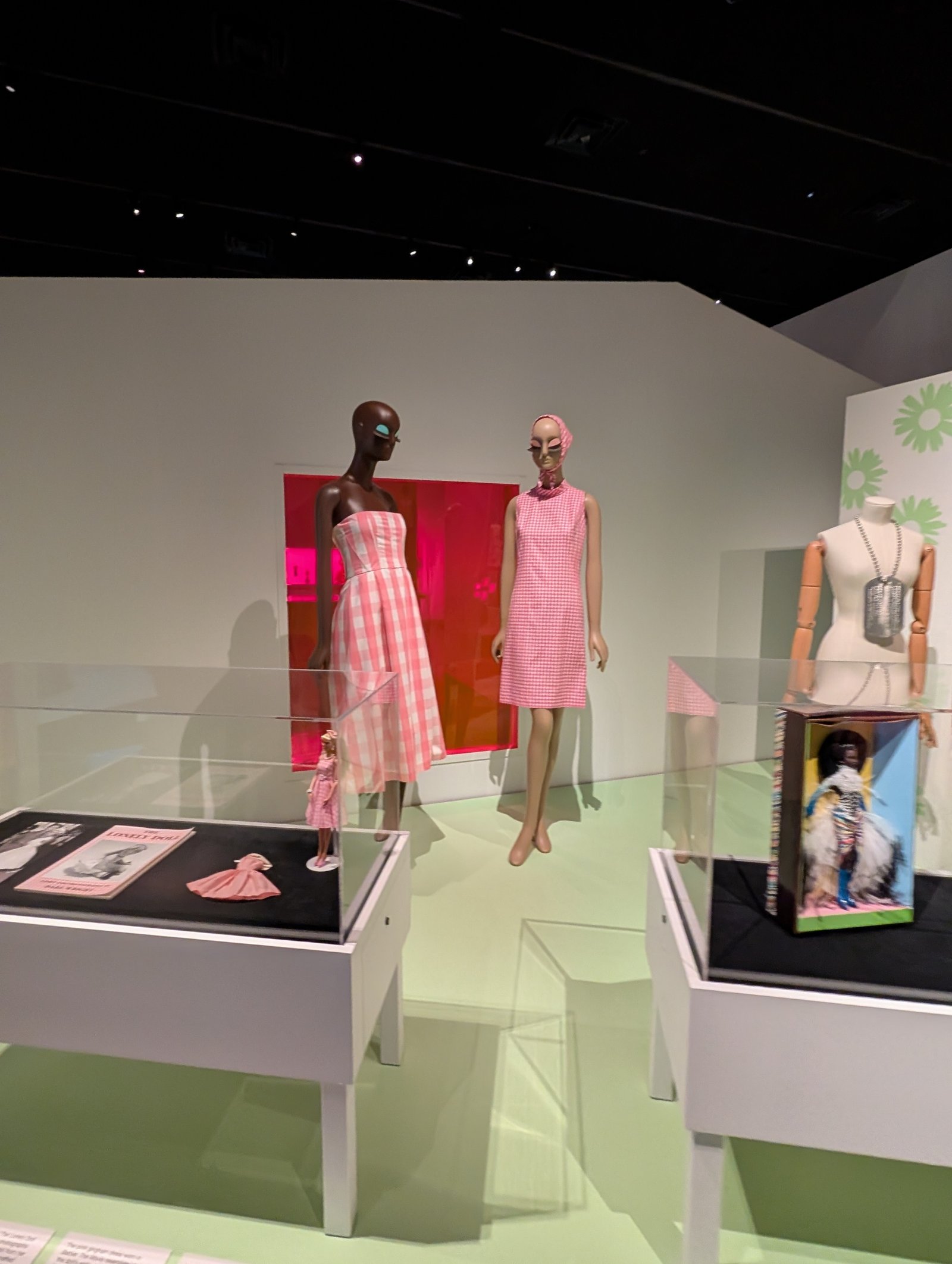
Pink Gingham: From Bardot’s Wedding and Biba to Margot Robbie and Zara
One of the brightest, most vibrant, and most playful sections of Doll Dressing at The Museum at FIT is titled “Pink Gingham.” After Hans Bellmer’s shadowy surrealism, disassembled doll joints, and Courtney Love’s punk defiance, this gallery feels like a breath of fresh summer air.
Soft pink gingham, or vichy, as it is known in France, evokes playful sundresses, sunny picnics, girlish pink daydreams, Brigitte Bardot, the legendary Barbie, and the vast promotional universe surrounding Greta Gerwig’s Barbie film. Yet the museum’s curators make a persuasive case that even the most carefree-looking fabric can carry a powerful cultural code: one that has shaped ideas of girlhood, youth, playful prettiness, and fashionable nostalgia for decades.
Brigitte Bardot, Vichy, and 1959
The history of pink gingham in international fashion is inseparable from Brigitte Bardot. On June 18, 1959, she married actor Jacques Charrier in a dress by Jacques Estérel made from simple pink-and-white vichy fabric.
For the period’s wedding conventions, it was genuinely startling: no heavy satin, sweeping train, or elaborate embroidery. Instead, Bardot chose a modest cotton check associated with summer picnics or kitchen curtains, transforming it into a symbol of youthful, rebellious femininity and creating an international style sensation.
With its defined waist, fitted bodice, full skirt, and tender color, the dress had an unmistakably doll-like look. This iconic image became a natural starting point for a story that leads straight to Barbie.
Biba and the “Dolly Bird”
Another major breakthrough for pink gingham came in London in 1964, thanks to Barbara Hulanicki and her groundbreaking label, Biba.
Hulanicki offered a remarkably simple pink gingham dress with a matching headscarf through a mail-order catalogue. The response surpassed every expectation: Biba received 17,000 orders. Producing the design required approximately 25,000 metres of pink gingham, an extraordinary amount for one youthful fashion phenomenon.
This Biba dress helped to define the look of the dolly bird: the young London fashion girl who embraced doll-like eyes, compact silhouettes, youthful makeup, and accessible yet highly stylized clothing. The term suggested a playful, fashionable femininity, a look that was deliberately youthful rather than traditionally formal or ladylike.
The exhibition includes a beautiful contemporary reproduction of Biba’s celebrated 1964 pink gingham dress and scarf, made by Matthew Carlsen in 2026. Its presence makes clear how much this apparently simple design helped to shape the visual language of Swinging London.
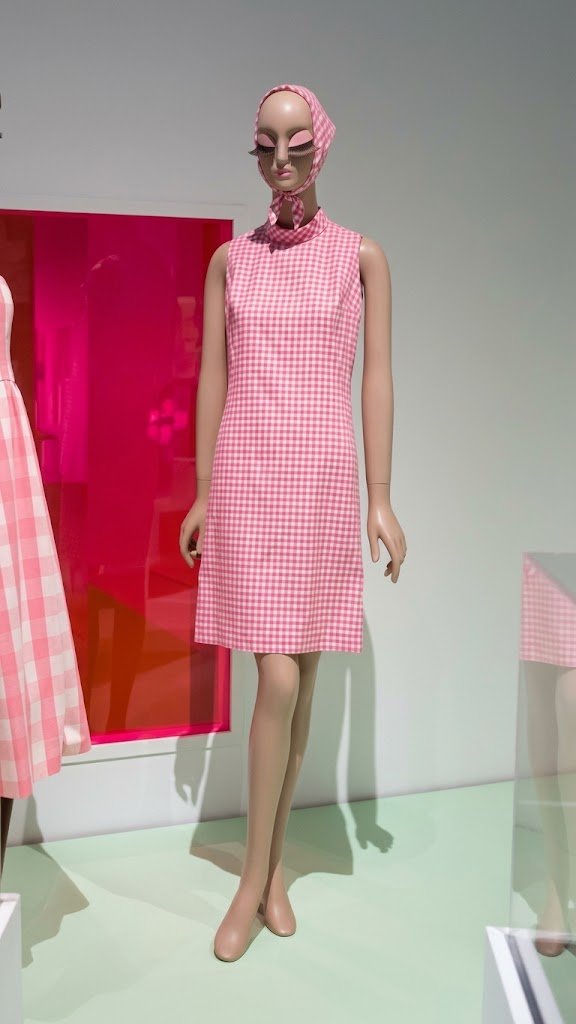
Reproduction of Biba’s 1964 pink gingham cotton dress and scarf, 2026
Biba’s mail-order dress and scarf 1964 democratized the “dolly bird” look for thousands of young women in Britain.
Barbie: 1965 to 2023
Mattel’s “Dancing Doll” Barbie 1965 established pink gingham, white pumps, and a miniature record player as a classic Barbie fashion story.
The costume was not simply a new invention by the film’s costume designers. It directly recalls Mattel’s vintage “Dancing Doll” Barbie ensemble from 1965: a pink gingham dress, white pumps, and a tiny record player. In the exhibition, the original 1965 doll dress is displayed alongside the 2023 Barbie: The Movie doll wearing its corresponding outfit.
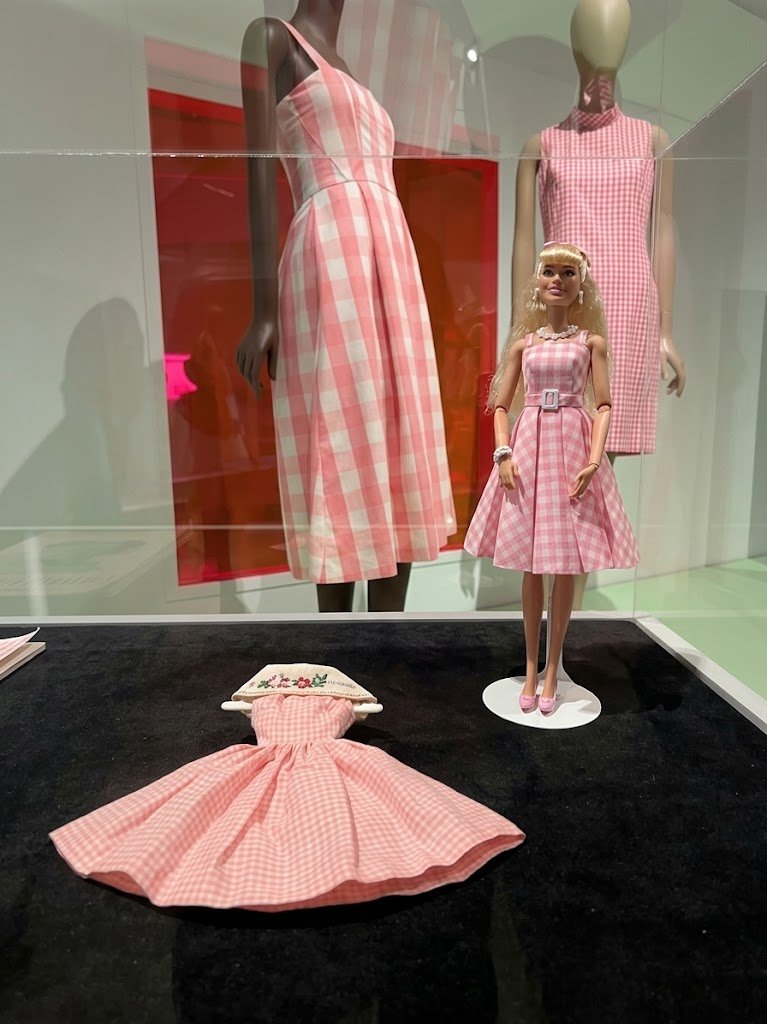
Mattel
Pink gingham “Dancing Doll” dress for Barbie, 1965 Private collection
Mattel
Barbie: The Movie doll in pink gingham dress, 2023 Private collection
Margot Robbie in Barbie 2023 reintroduced the archival Barbie look to a vast contemporary audience through cinema.
The undisputed star of this section is, naturally, Barbie herself. When Margot Robbie appears as Stereotypical Barbie in Greta Gerwig’s Barbie wearing a pink-and-white gingham sundress, the look reads instantly as quintessential Barbie.
That pairing demonstrates precisely how Barbie nostalgia works. The cinematic costume looks fresh, cheerful, and perfectly suited to the film’s hyper-designed Barbie Land. Yet its visual language had been carefully preserved in Mattel’s fashion history for almost sixty years.
The commercial scale of the revival was equally striking. Gerwig’s Barbie became a global phenomenon, earning approximately $1.36 billion worldwide in less than two months, while its costumes quickly became recognizable beyond the film itself.
Zara x Barbie
The Movie 2023 brought the doll-inspired silhouette into mass-market adult fashion.
The final note in this section is the Zara x Barbie: The Movie pink cotton gingham sundress from 2023. The garment was displayed “on-card,” in an enlarged version of the packaging used for doll clothing. It was an exceptionally clever curatorial choice: a full-size dress for an adult body was transformed back into a toy-like fashion object.
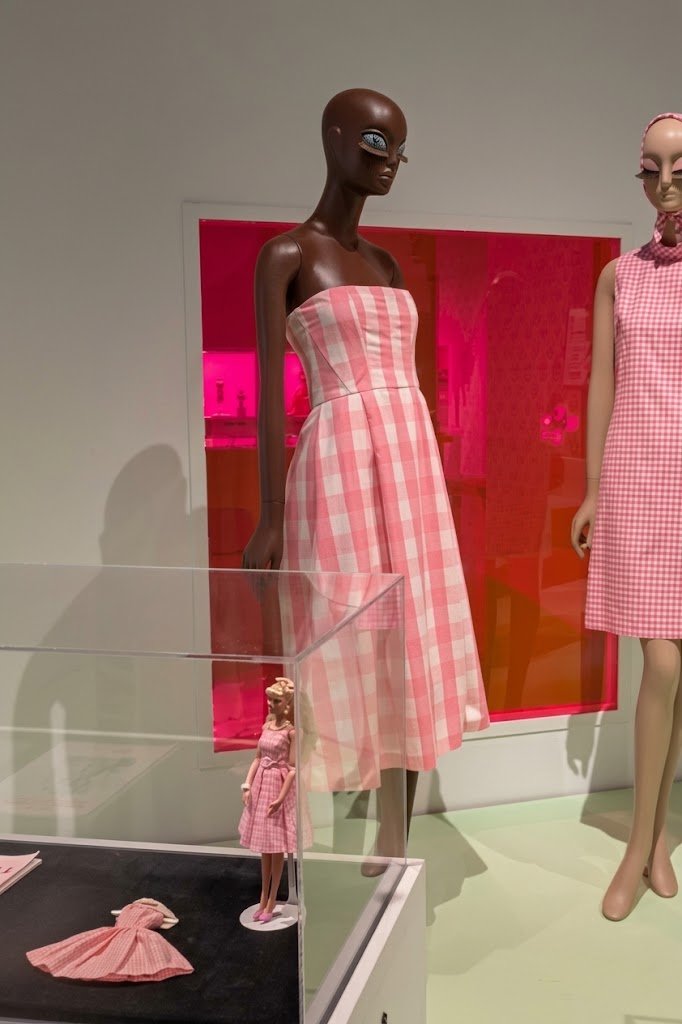
Pink cotton gingham sundress, 2023 MFIT, museum purchase
The display seemed to wink at visitors. It invited them not merely to buy a dress, but to step into an entire ready-made fantasy: the outfit, the hair, the attitude, the pink palette, and the carefree imaginary world that comes with Barbie.
A Chain Reaction in Pink
This is what makes the gallery so satisfying: it does not present doll fashion as a minor footnote to “real” fashion. Instead, it shows a two-way exchange. A fabric and silhouette can move from an adult celebrity’s wedding dress to a doll, from a doll archive to a film costume, and then back into full-size clothing for shoppers.
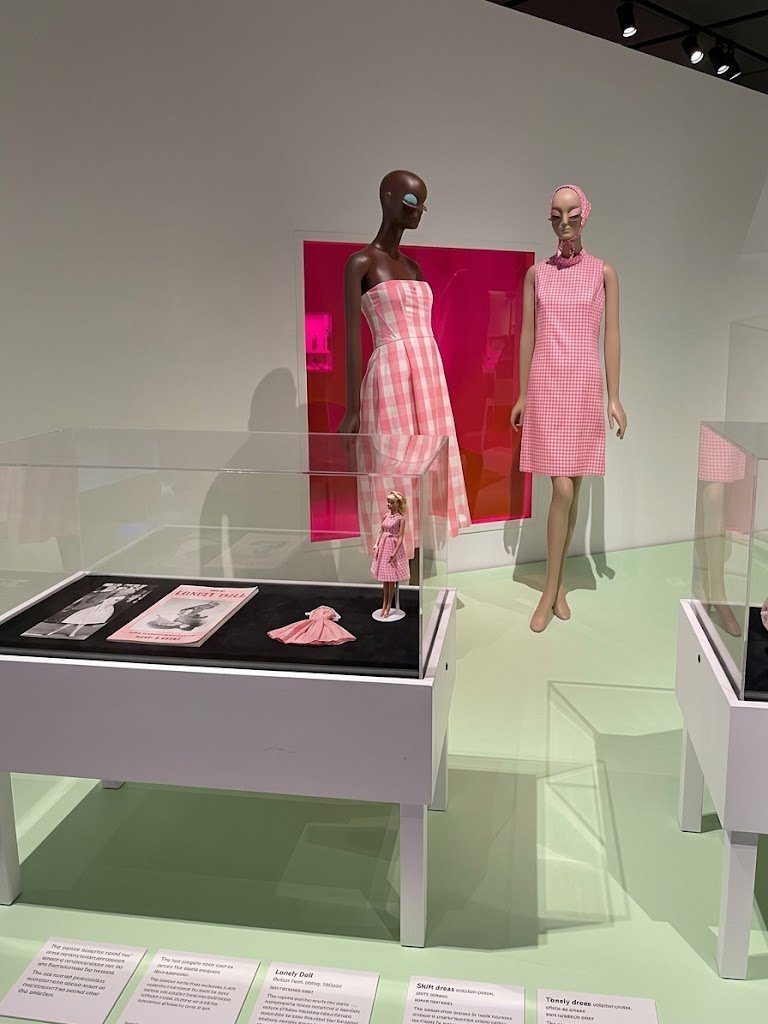
Pink gingham turns out to be far more than a sweet retro print. It is a universal language of fashion memory: from a handmade childhood doll dress to Bardot’s famous wedding, from Biba’s cult mail-order catalogue to a Hollywood blockbuster and Zara’s mass-market shop windows.
We may grow up, but our dolls continue to suggest what we might wear next spring.
Sources & Further Reading
- The Museum at FIT. Doll Dressing exhibition. The exhibition brings together more than 170 objects exploring the long relationship between dolls, dress, fashion imagery, and adult style.fitnyc
- The Museum at FIT. Current and upcoming exhibitions. Doll Dressing is presented in the Special Exhibitions Gallery from September 16, 2026, through January 3, 2027.fitnyc
- Smithsonian Magazine. “Centuries Ago, Royals Dressed Up Their Dolls to Share the Latest Fashions”. An overview of the exhibition and the historical connections between dolls, miniature wardrobes, fashion dolls, and full-scale design.smithsonianmag
- Women’s Wear Daily. “Zara Releases Barbie Collection With Apparel, Beauty Products and More”. Coverage of the Zara x Barbie capsule collection released ahead of the film’s July 2023 premiere.wwd
- D’SCENE. “Discover Zara Barbie Capsule Collection”. A visual overview of the 2023 Zara collection inspired by Greta Gerwig’s Barbie, including clothing, accessories, beauty products, and home items.designscene
- The Museum at FIT. Doll Dressing social-media material. Exhibition-related announcements and the museum’s public project, We Love Dolls!, created in connection with the exhibition.