
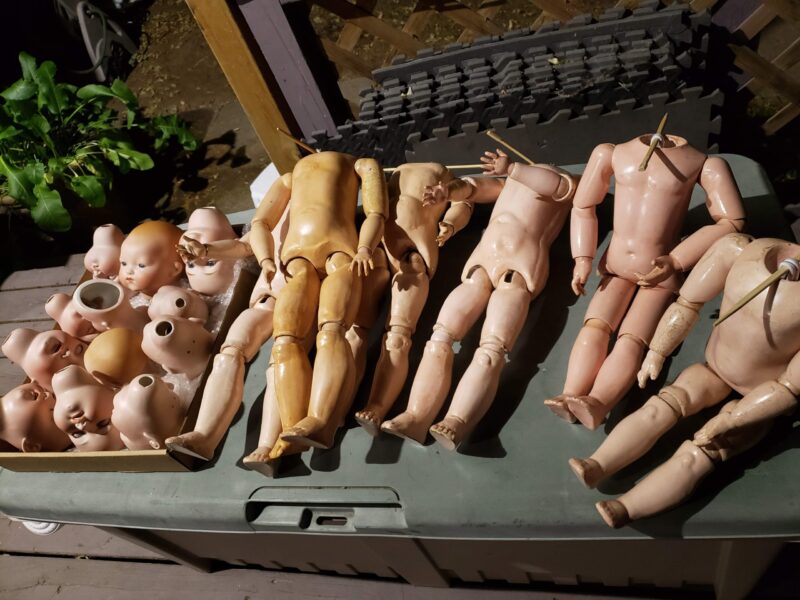
Waltershausen & Sonneberg (Thuringia) as a Centers of Doll‑Body Production
Germany was the center of the doll‑making industry in the 19th and early 20th centuries, but not all companies produced fully composition bodies themselves. Often, the heads were manufactured separately, while the composition bodies were purchased from or produced by other firms.
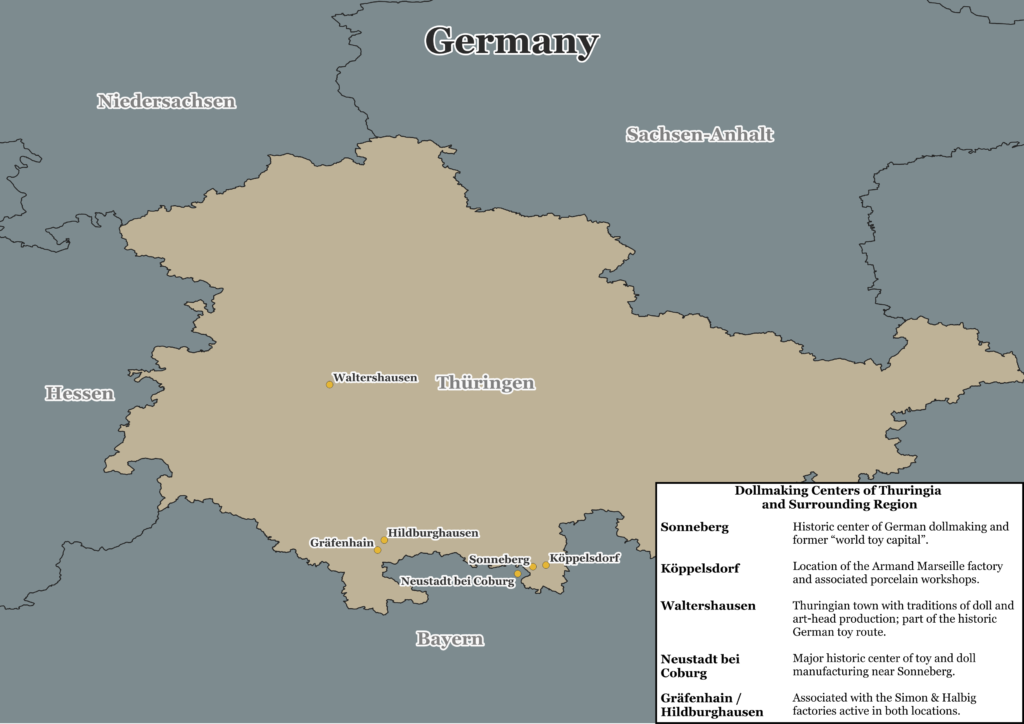
What’s Important to Know for Identification
Markings: Many antique composition dolls have markings on the body or neck, sometimes very brief (initials, a number, or short text).
Composition: Composition bodies are made from a mixture of glue, wood dust, paper, and other fillers that are pressed or molded into shape.
Era: the peak period of composition bodies was approximately 1900-1950, after which plastic gradually replaced composition.
Waltershausen in Thuringia was one of the key regions for specialized doll‑body manufacturing in the late 19th and early 20th centuries. Unlike other parts of Germany dominated by large brand‑name factories, this area developed a unique network of workshops and small manufacturers that primarily supplied components rather than complete dolls.
Producers in Waltershausen created a wide range of doll bodies, including:
- composition bodies,
- wooden bodies,
- combined constructions (wood + composition).
These bodies were shipped both to nearby Sonneberg (the major center for doll‑head production) and directly to exporters. Manufacturing was serial, yet characterized by noticeable variations in shapes, proportions, and construction methods.
Local workshops operated mainly as independent body makers. They produced bodies as standalone components, supplied larger manufacturers with parts, and created products for both domestic use and export.
Due to this decentralized model, most bodies from Waltershausen carried no factory markings, making precise attribution difficult.
The designation “Waltershausen doll body” is not a brand. It is an indication of the geographical and technological origin of the product. That is why in museum and collection practice, it is correct to use the terms: Waltershausen-type body or Waltershausen production.
This wording helps to accurately classify the doll, even when the manufacturer of a particular body is unknown.
Waltershausen is a type of production and a region, so it involves consistent technical patterns, rather than a single form.
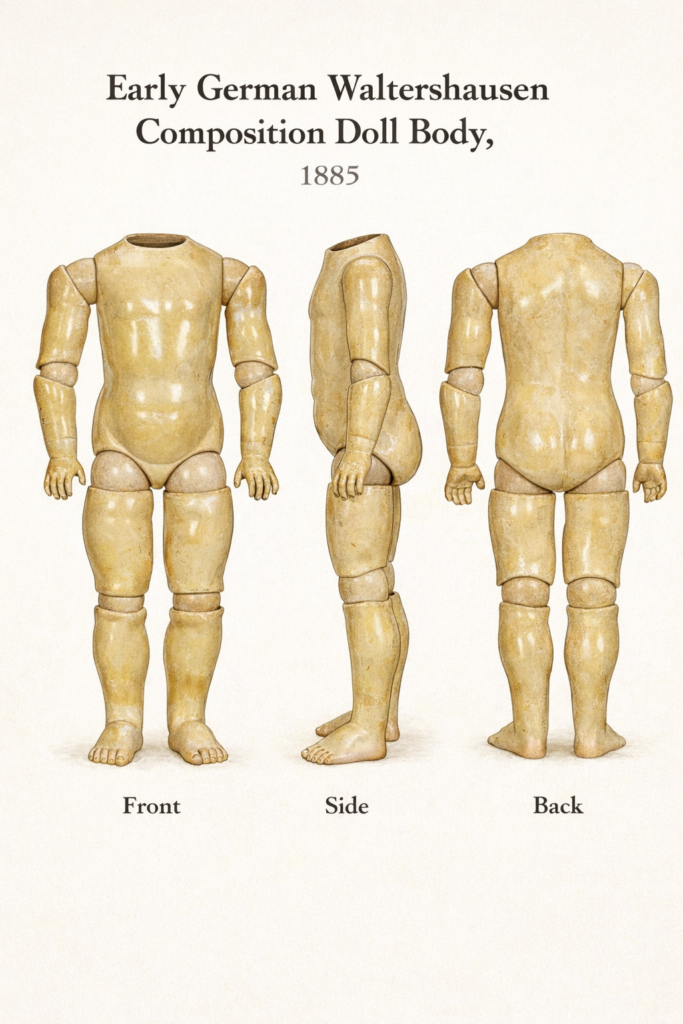
Waltershausen doll body,
ca. 1885–1895
Fully jointed with articulated shoulders, elbows, hips, and knees. Typical of early Thuringian production.
Construction: Body separate from limbs, large hip and shoulder joints shown for articulation.
Surface: Yellow finish.
Physiology: Pronounced musculature, plump build; high shins; straight wrists. Toes indicated schematically (not cut through).
Purpose: For the Kestner factory.
Waltershausen doll body,
ca. 1885–1890
Surface: creamy finish
Construction: showcasing voice box bodies controlled by string; detailed knees and hips.
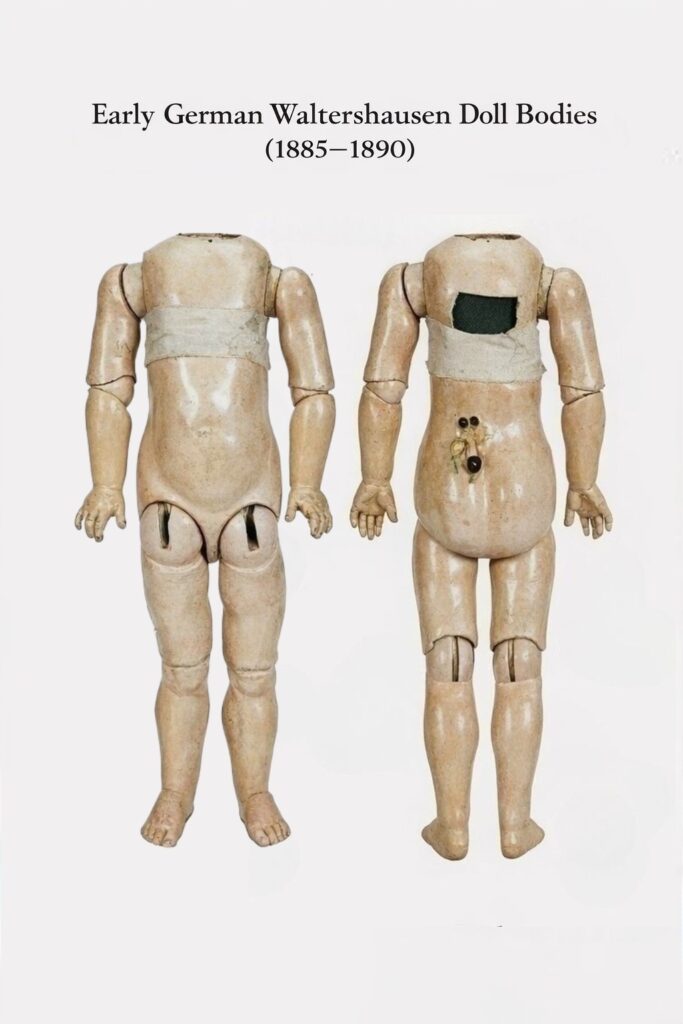
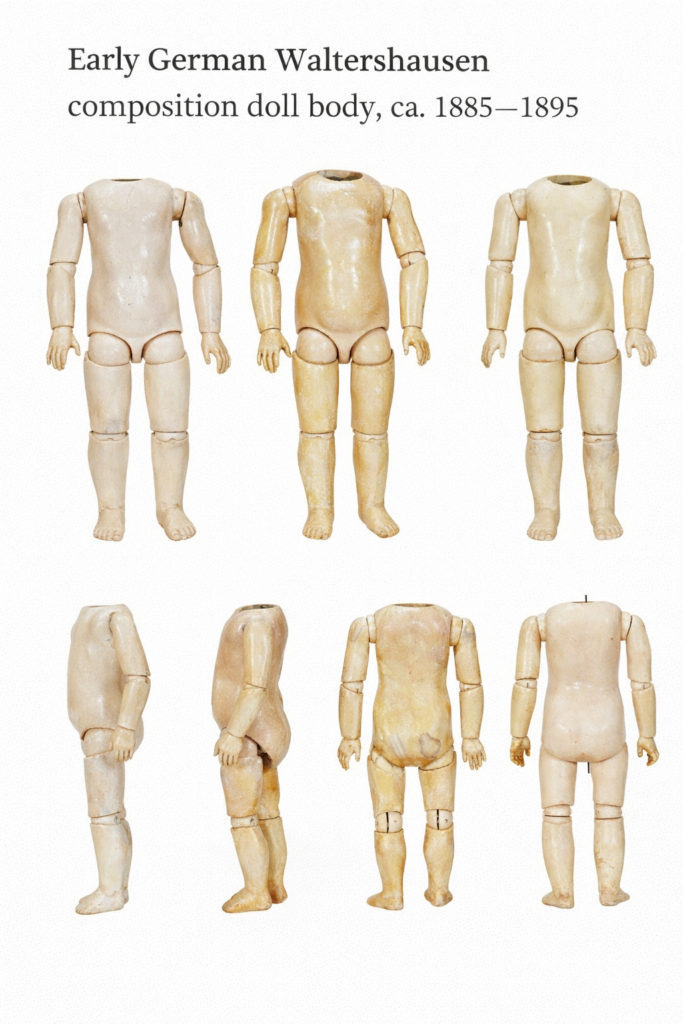
Waltershausen doll body,
ca. 1885–1895
Surface: Soft creamy finish
Construction: Straight and movable wrists; one model with an elongated inguinal fold
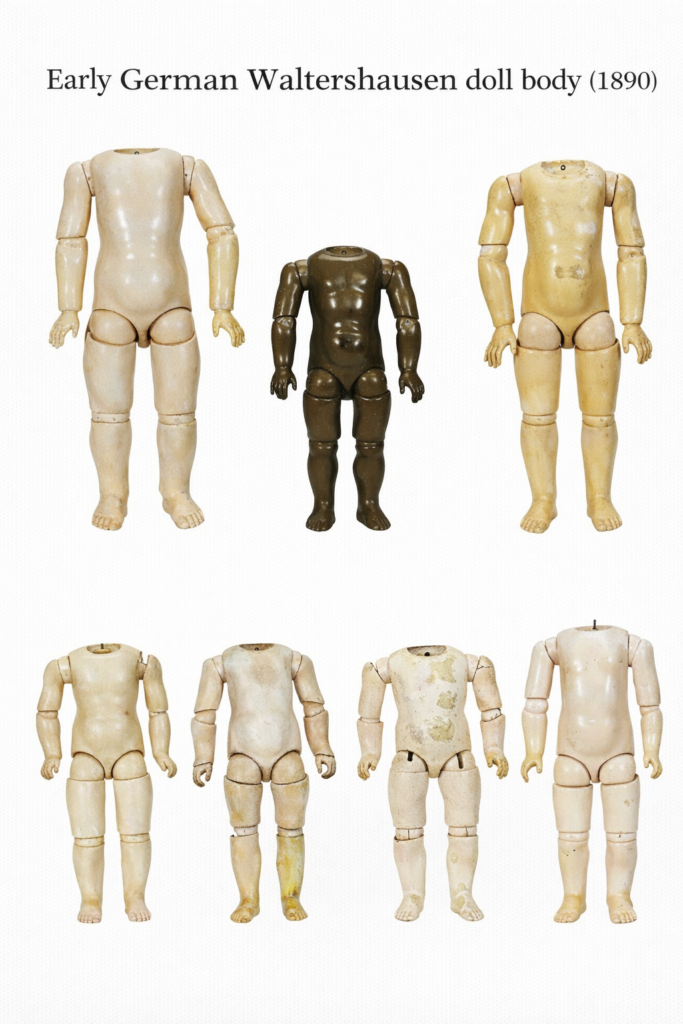
Waltershausen doll body,
ca. 1890
Construction: Hip and shoulder joints attached; wrists straight.
Surface: Dark chocolate finish; creamy finish on base models.
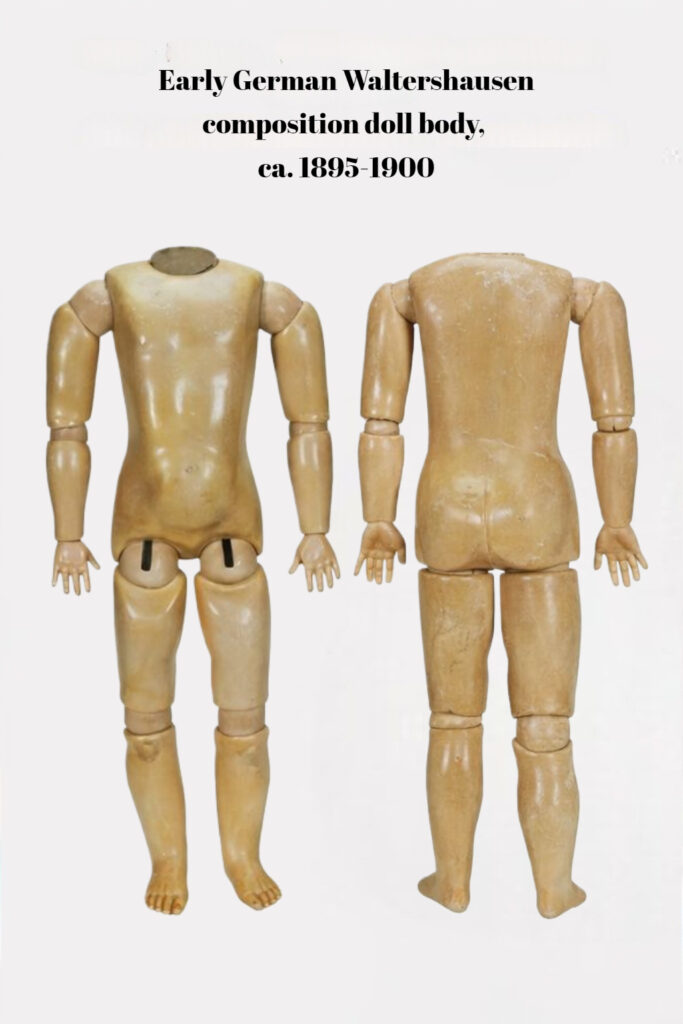
Waltershausen doll body,
ca. 1885–1900
Surface: Dark yellow and creamy finish; patella blushing.
Construction: Detailed fingers and toes, nails; rectangular torso.
Purpose: from Handwerck.
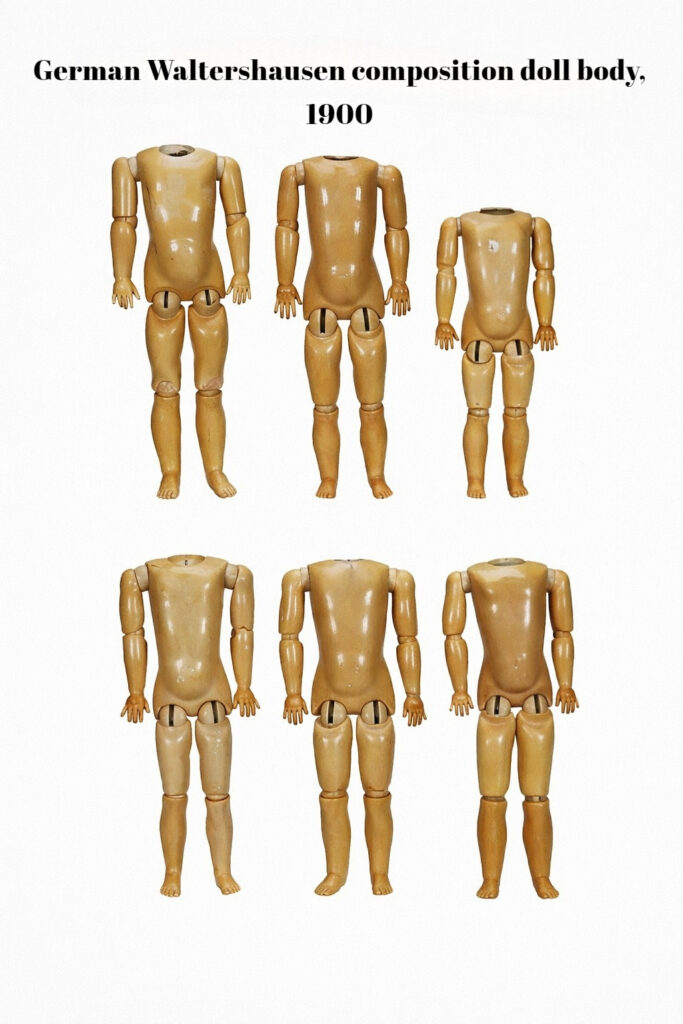
Waltershausen doll body,
ca. 1900
Surface: Yellow finish, red factory stamps.
Purpose: The first sample was used by several manufacturers. 5 samples for the Kestner factory.
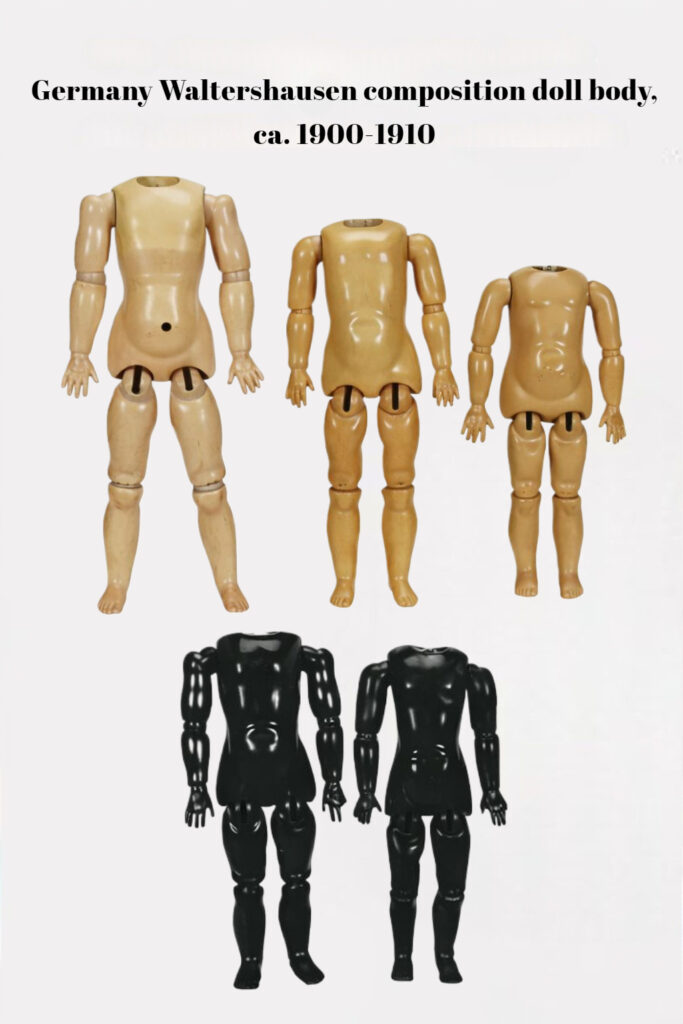
Waltershausen doll body,
ca. 1900-1910
Surface: Body with cream and dark yellow finishes; an amber-yellow finish, designed for an Asian-type doll, also ebony black.
Construction: Detailed fingers and toes.
Torsos with pronounced tummies, but with shape options.
Purpose: black body for the Kestner factory.
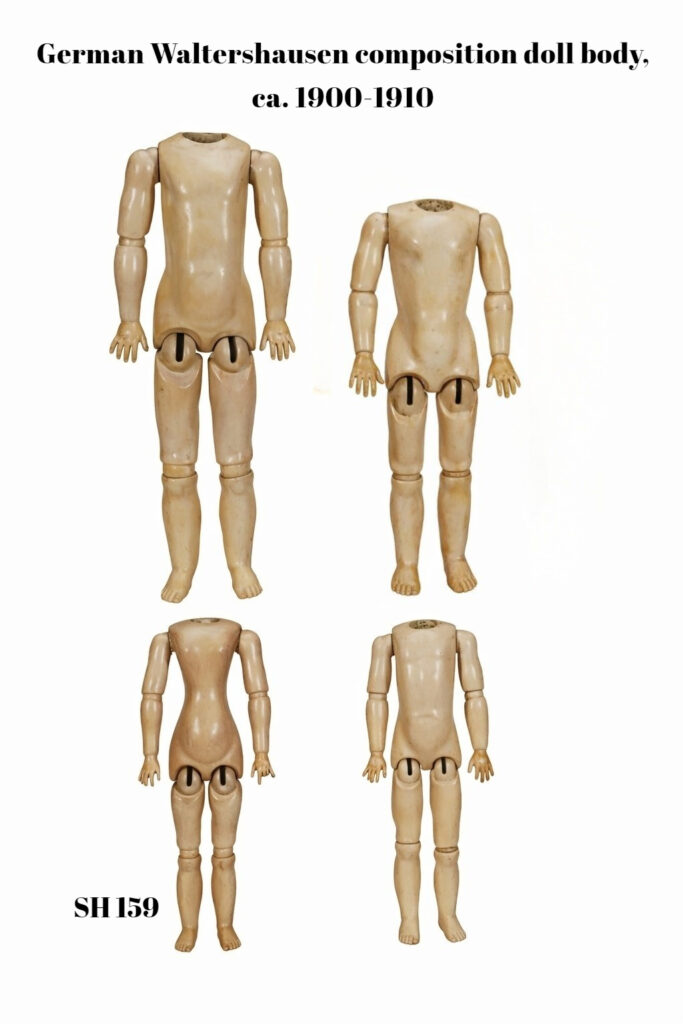
Waltershausen doll body,
ca. 1900-1910
Surface: Creamy and yellow finish.
Construction: Wood composite articulated bodies.
Purpose: two bottom ones for the Heinrich Handwerck factory.
SYSTEMATIC ANALYSIS OF THE WALTERSHAUSEN FEATURES OF DOLL BODIES
SEAMS (mold seams / assembly seams)
Typical features: Longitudinal seam in the center of the torso. Often: clear, straight, runs from the neck to the groin. On early specimens (≈1885–1895), the seam may be partially smoothed by hand, but not destroyed. On the limbs: side or back seams, not on the inside (unlike later massive bodies).
Diagnostically important: The seam is not decorative, not hidden. The body was formed from two halves, and not cast monolithically.
JOINTS AND EXTREMITY ATTACHMENTS
Shoulders: Direct insert attachment or simple ball joint. Shoulders appear massive, movement limited (not a “poseur doll”).
Hips: Characteristic feature is a pronounced inguinal fold, sometimes asymmetrical.
Hip joint: Deeply set, with minimal play.
Wrists/ankles: Mostly straight, no balls, no additional inserts. Movement is technically possible, but not decorative.
BODY PROPORTIONS (anatomical profile)
General silhouette: the body is dense, compact
Torso: shorter in relation to the legs, the chest is wider than the waist (even in “children’s” models).
Shoulder girdle: broad shoulders are one of the most stable features. Even with a small doll’s height, the body looks “strong”.
Legs: the upper part of the thigh is massive, with a clear anatomical logic, but without excessive detail.
Knees: often without a separate hinge, the shape is slightly smoothed.
SURFACE AND MATERIAL
Surface texture: matte or semi-matte, with a slight “grain”. Small pores are often visible, the material is not homogeneous.
Typical color options: dark chocolate, warm cream, grayish beige. The color is not completely even – this is not a defect, but a sign of a manual or semi-manual process.
MARKING (or lack thereof)
What we usually see is the absence of a brand. Sometimes there is a shape number, a size number, very rarely the initials of the workshop (non-branded). This is normal. For Waltershausen, the absence of marking is more the norm than the exception.
Key takeaway: Waltershausen is where the bodies were made. Sonneberg is where they were made into dolls and sold to the world. That is why in scientific descriptions, catalogs, and serious collections: “Waltershausen body, Sonneberg assembly” is an absolutely correct formula.
Sonneberg (Thuringia) was the main trade and assembly center of the European doll industry
(often referred to as “Weltspielwarenstadt” — the world’s toy capital).
Sonneberg did not specialize specifically in doll bodies, but instead collected components from various regions, assembled complete dolls for export, marked and sold them under company trade names.
A typical production chain looked like this: the body was made in Waltershausen; the head came from Sonneberg, Koppelsdorf, Neustadt, or from Simon & Halbig / Armand Marseille; and the final assembly and export took place in Sonneberg.
The same doll might have a Simon & Halbig head, a Waltershausen body and be sold as a Sonneberg doll.
Sonneberg-type body is not a production school of bodies, but a assembly-trade type, formed in the environment of mass assembly and export. Therefore, there is less “technological rigor” and more variability.
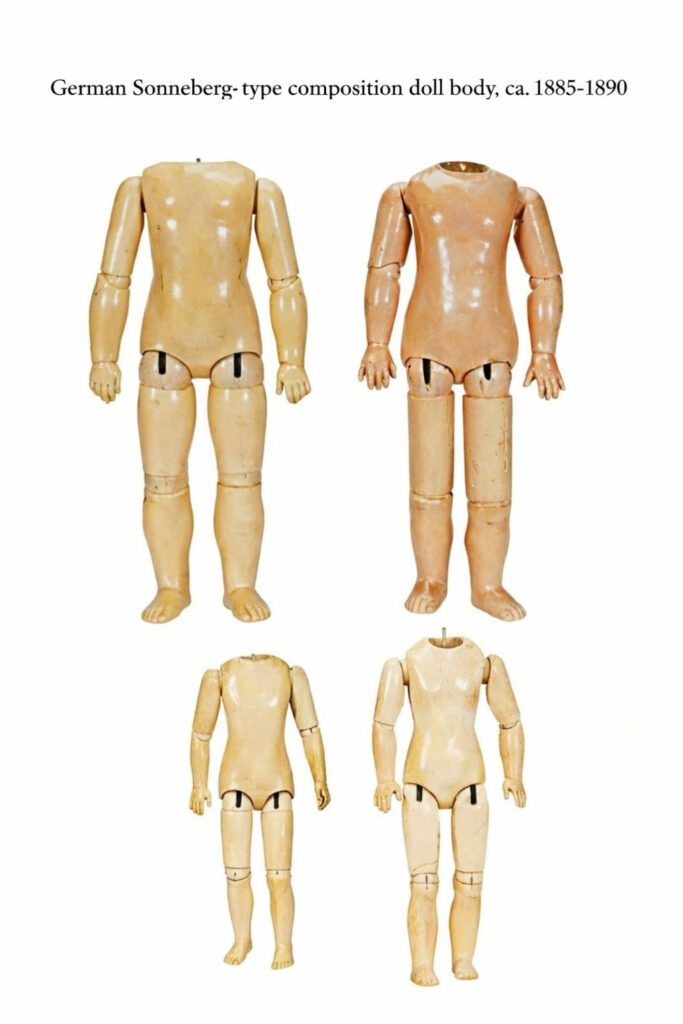
Sonneberg-type doll body,
ca. 1885-1890
Surface: Creamy finish.
Construction: rectangular torso.
Straight wrists.
Elongated hip with a ball or right angle joint.
Purpose: for the factories Simon and Halbig, Kunlenz, and also sold to other manufacturers (do not specify).
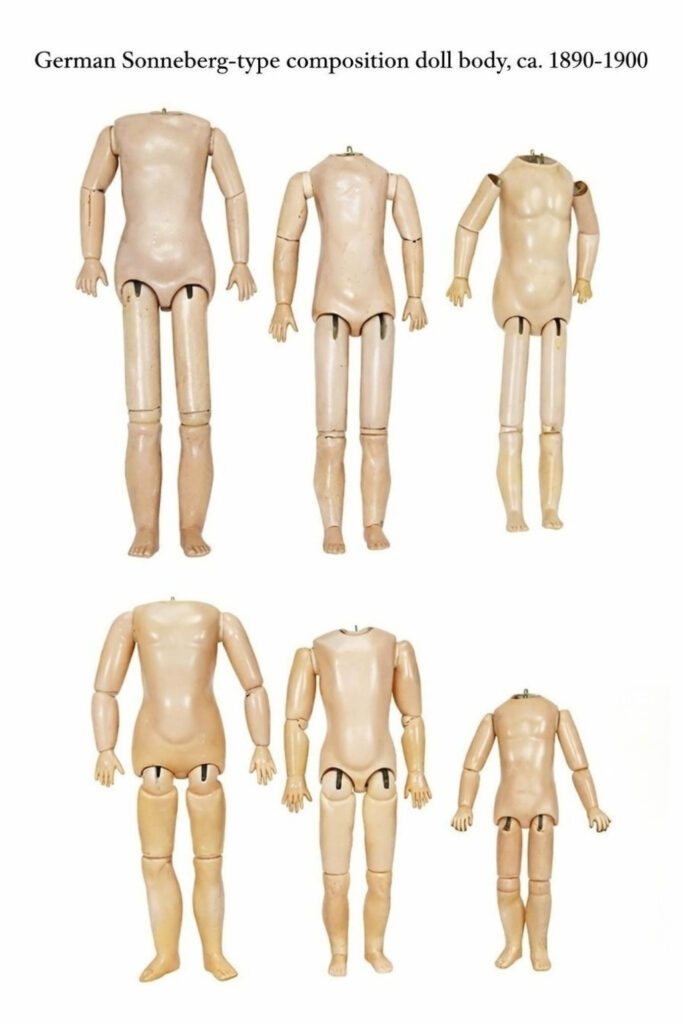
Sonneberg-type doll body,
ca. 1890-1900
Surface: Creamy finish
Construction: rectangular torso.
For different factories of the Sonneberg era.
Purpose: for the Kuno Dressel factory, for Dressel and Heubach dolls (the 1910s).
Sonneberg-type doll body,
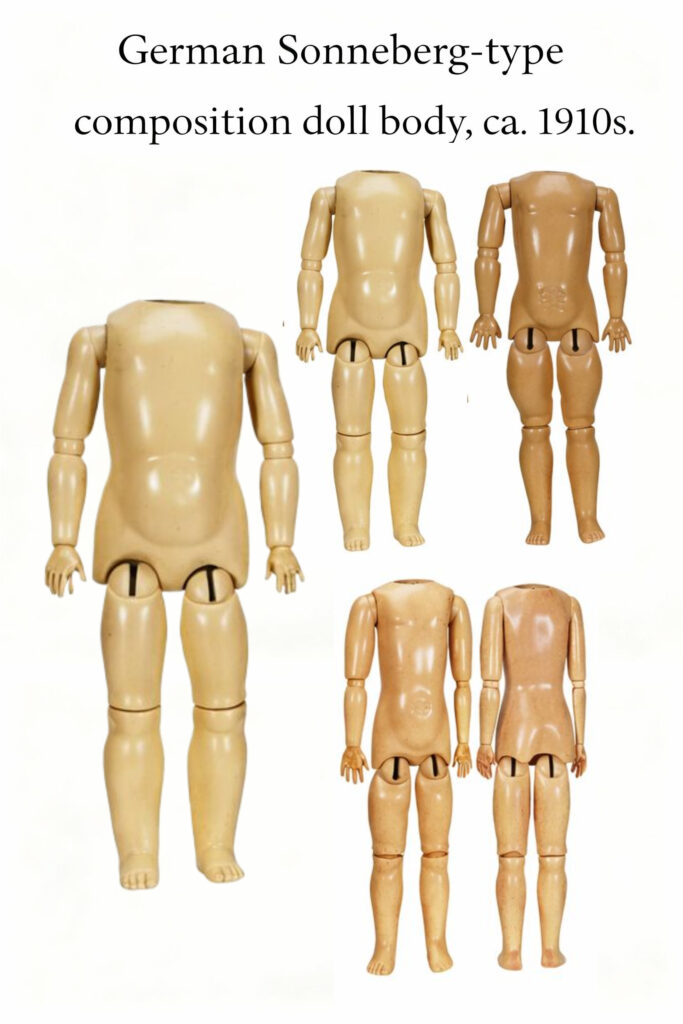
ca. 1910s
Surface: Creamy and dark yellow finish. Stamp “Made in Germany”.
Construction: Composite torso with a pronounced tummy; detailed toes and kneecaps.
Purpose: Used by different factories of this era.
Sonneberg-type doll body,
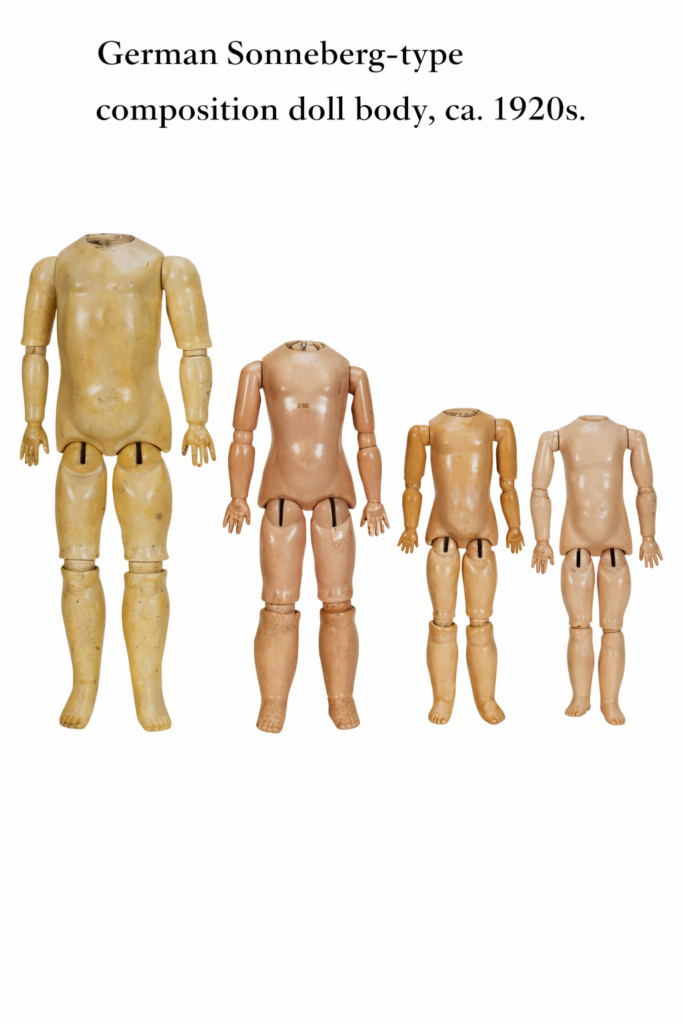
ca. 1920s
Surface: Creamy finish. Only one sample has a slightly pinkish tinge. This sample also has a pronounced butt.
Construction: Part of the arm is elongated (from the elbow to the hand, it is longer than the earlier samples).
Pronounced fold in the interfemoral space, pronounced patella, and toes.
Purpose: Used by different factories of this era.
AN ANALYSIS OF SONNEBERG-TYPE BODIES
SEAMS (mold seams / finishing seams)
Typical features: The central seam of the torso is often weakly expressed or almost smoothed
Seams: can be uneven, sometimes “disappearing” in the upper part of the torso.
On the limbs: the seams are often better cleaned than in Waltershausen, oriented towards visual neatness rather than technological logic.
Attributionally important: Sonneberg bodies were more often finished before sale, as they were finished goods rather than semi-finished goods.
JOINTS AND ATTACHMENTS
Shoulders: Freer movement than in Waltershausen. Often, a rounded socket, a softer fit of the limb. Orientation to the “play” function, presentability in the store.
Hips: The Inguinal area is less anatomically pronounced
Foot joint: simpler, less deep, sometimes almost conditional.
Wrists/ankles: more often hemispherical or shaped shapes, decorative roundings. In later models, attempts to imitate more complex hinges.
PROPORTIONS (silhouette and balance)
Torso: Longer, narrower in the shoulders. Visually, the body looks lighter, less “industrially massive”. The overall silhouette is more slender than Waltershausen.
Shoulder girdle: Shoulders do not dominate, smoothly flowing into the arms. Often better coordinated with the size of the head (especially Armand Marseille, Simon & Halbig).
Legs: Thighs are thinner, less “construction”. Knees are often smoothed, without clear anatomical accentuation.
SURFACE AND MATERIAL
Surface texture: smoother than Waltershausen, less grainy.
Often noticeable: leveling, thinner paint layer.
Typical color: light cream, pinkish-beige. The color is more uniform, oriented towards the mass market.
MARKING
Possible: stamping GERMANY / MADE IN GERMANY, mold numbers, export marks.
This does not indicate a specific factory because this is a trade, not a production marking.
The Sonneberg-type body is a body optimized for sales, while the Waltershausen-type is optimized for production.
Waltershausen vs Sonneberg doll bodies (Thuringia, Germany, ca. 1885–1915).
Bodies of the Waltershausen type reflect a production-oriented approach typical of specialized body-making workshops: compact proportions, broad shoulders, clearly visible central torso seams, deep-set and functionally simple joints, pronounced hip construction, and a matte, slightly granular composition surface, usually without factory marking.
In contrast, Sonneberg-type bodies represent a market-oriented, assembly-driven model: seams are often smoothed or minimized, proportions appear more slender and visually balanced, joints are lighter and more flexible, surface finishing is more uniform, and export markings such as “Germany” may be present.
These differences illustrate the distinction between Waltershausen as a manufacturing center for doll bodies and Sonneberg as a commercial hub focused on assembling and selling complete dolls.
Key takeaway: Waltershausen is where the bodies were made. Sonneberg is where they were made into dolls and sold to the world. That is why in scientific descriptions, catalogs, and serious collections: “Waltershausen body, Sonneberg assembly” is an absolutely correct formula.
RECOMMENDED SOURCES
Theriault, Florence. The Body Book.
Key reference on antique doll bodies, focusing on construction, joints, proportions, and materials.
Richter, Lydia. Thüringer Puppen.
Historical overview of doll production in Thuringia, including Waltershausen and the Sonneberg region.
Noack, Karin. Deutsche Puppen 1800–1930.
Survey of German doll manufacturing with attention to regional characteristics and dating.
Museum für Spielzeug Sonneberg – publications and catalogues
Institutional sources on Sonneberg as a decentralized center of trade-based doll production.