
The Broken Doll: From Hans Bellmer & Comme des Garçons to Courtney Love & Kinderwhore
The next section of Doll Dressing at The Museum at FIT is perhaps the most unsettling yet visually magnetic. It traces how the image of the doll: sweet, broken, fragmented, or deliberately damaged, transcended surrealist photography to define high fashion, 1990s rock music, and underground culture.
Hans Bellmer’s Surrealism: The Anatomy of Unsettlement
At the heart of this section is surrealist artist Hans Bellmer. His disassembled, reconstructed doll sculptures and photographs from the 1930s and 1940s transform the human figure into an uncomfortable, vulnerable object.
His hand-tinted pastel photographs from Les Jeux de la poupée (1949) merge soft pinks and powder blues with uncanny anatomical distortions. This precise tension, between childhood sweetness and visceral discomfort, serves as the conceptual key to the entire gallery.
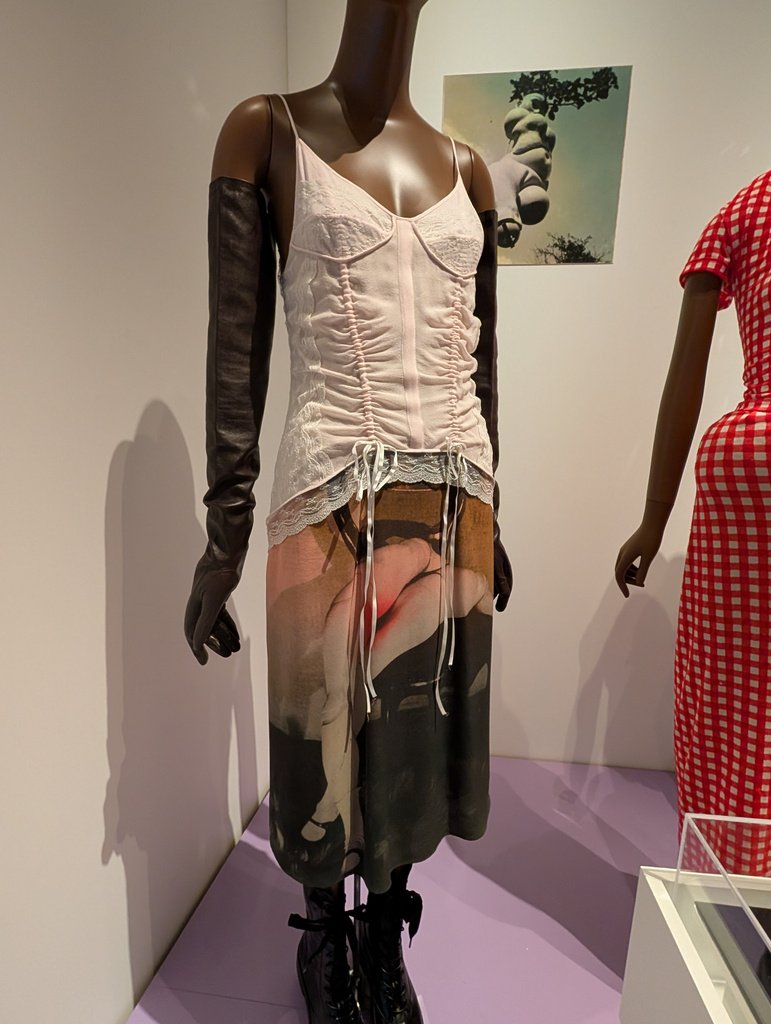
Pale pink silk and white lace dress printed with Hans Bellmer artwork, spring 2019
Lent by Olivier Theyskens
Concept: Theyskens noted that he was drawn to the lack of commercial merchandising around Bellmer’s art. The soft silk and lace temper the images without stripping away their surrealist bite.
Deconstructing the Body: Comme des Garçons & Dice Kayek
The dialogue between surrealism and avant-garde tailoring is striking:
Comme des Garçons (Rei Kawakubo): The iconic Body Meets Dress, Dress Meets Body collection (Spring 1997). A red-and-white gingham dress features soft padded protrusions that deliberately deform the silhouette, challenging conventional standards of symmetry and smoothness.
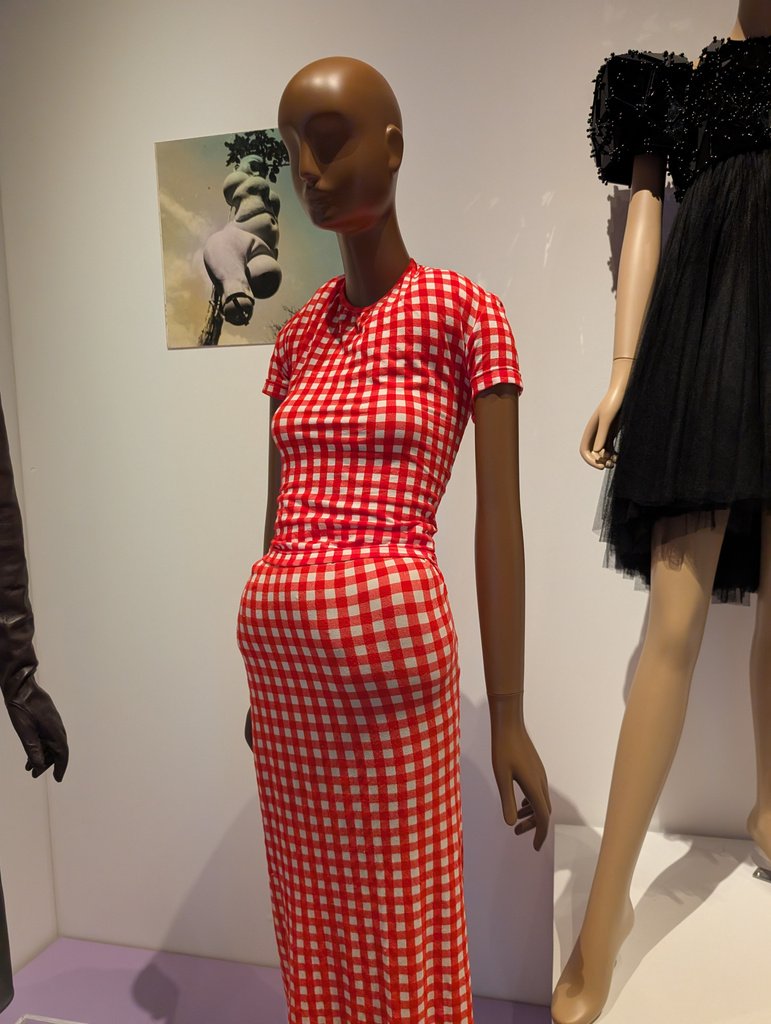
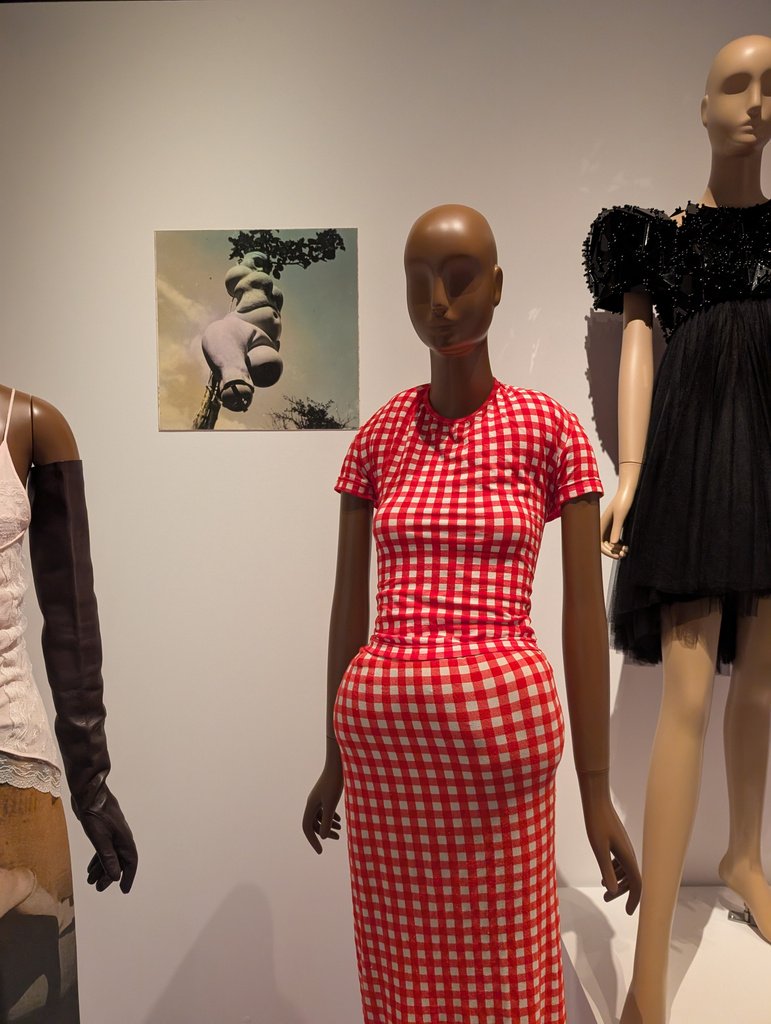
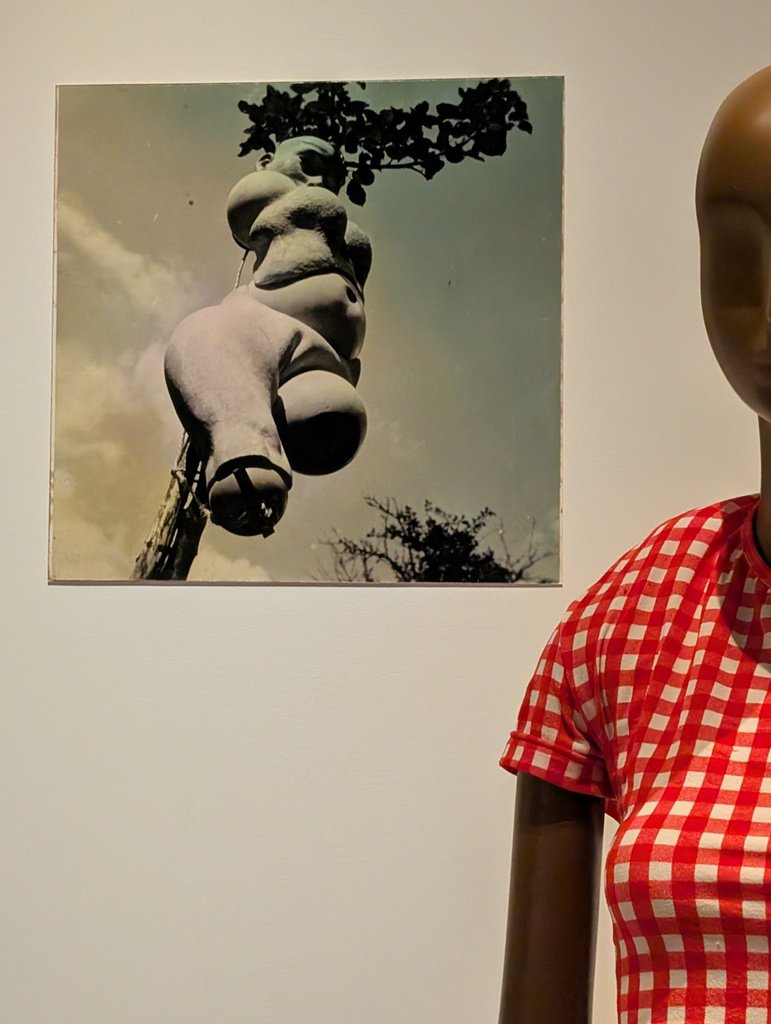
Red and white checkered synthetic dress, spring 1997 Body Meets Dress, Dress Meets Body collection MFIT, 2015.1.1, museum purchase
Mert Alas & Marcus Piggott: Photography for Visionaire No. 27 (Movement, 1999), featuring a contortionist model bound by rubber bands, evoking a jointed ball-jointed doll.
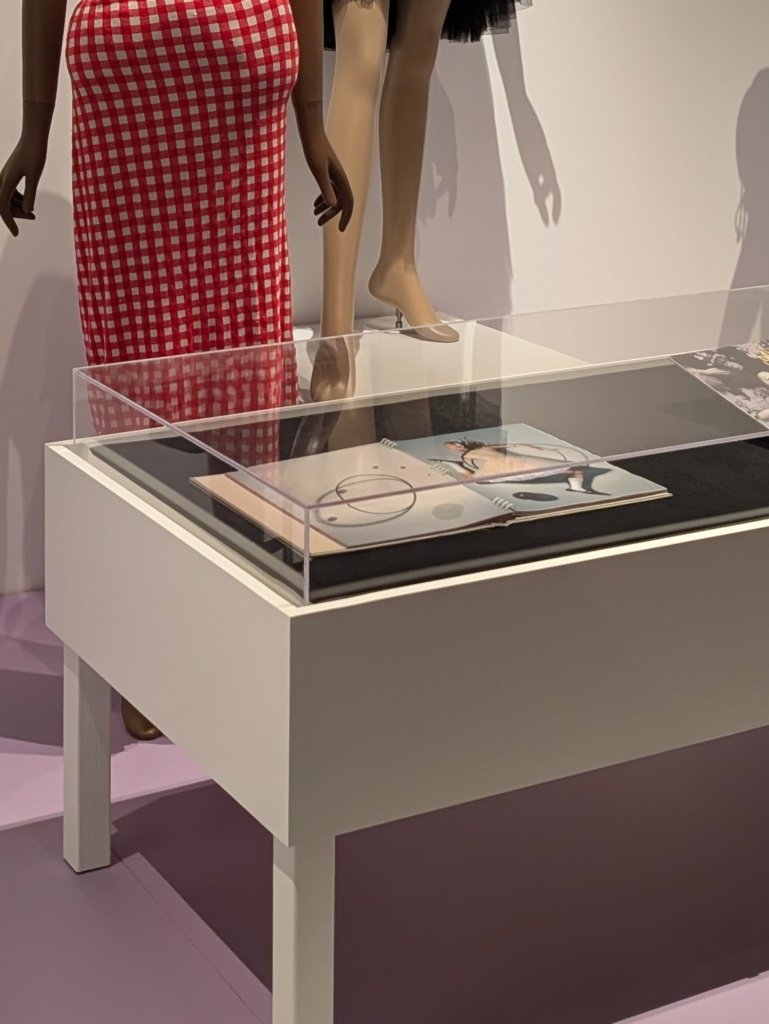
Visionaire no. 27, “Movement,” 1999 MFIT, museum purchase
Dice Kayek (Ece Ege): Dollhouse Couture collection (Spring 2015). A structured black bodice of silk and acrylic contrasts with a weightless tulle skirt. Inspired by Louise Bourgeois and Annette Messager, the design contrasts fragile childhood tulle with armor-like segmented protection.
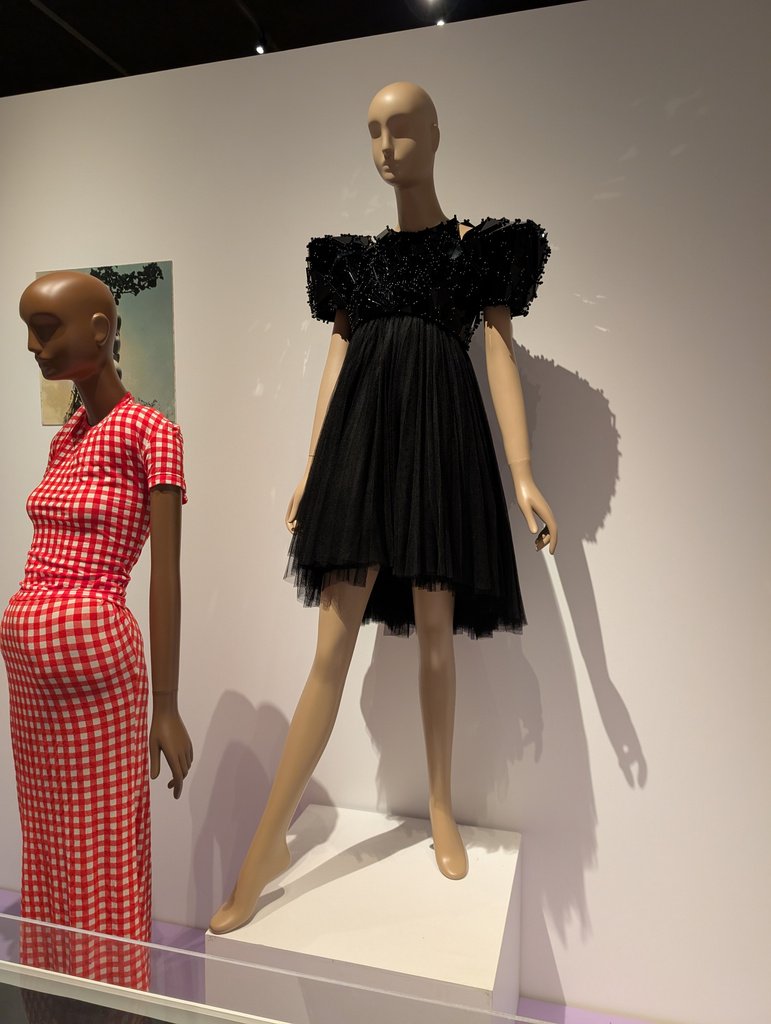
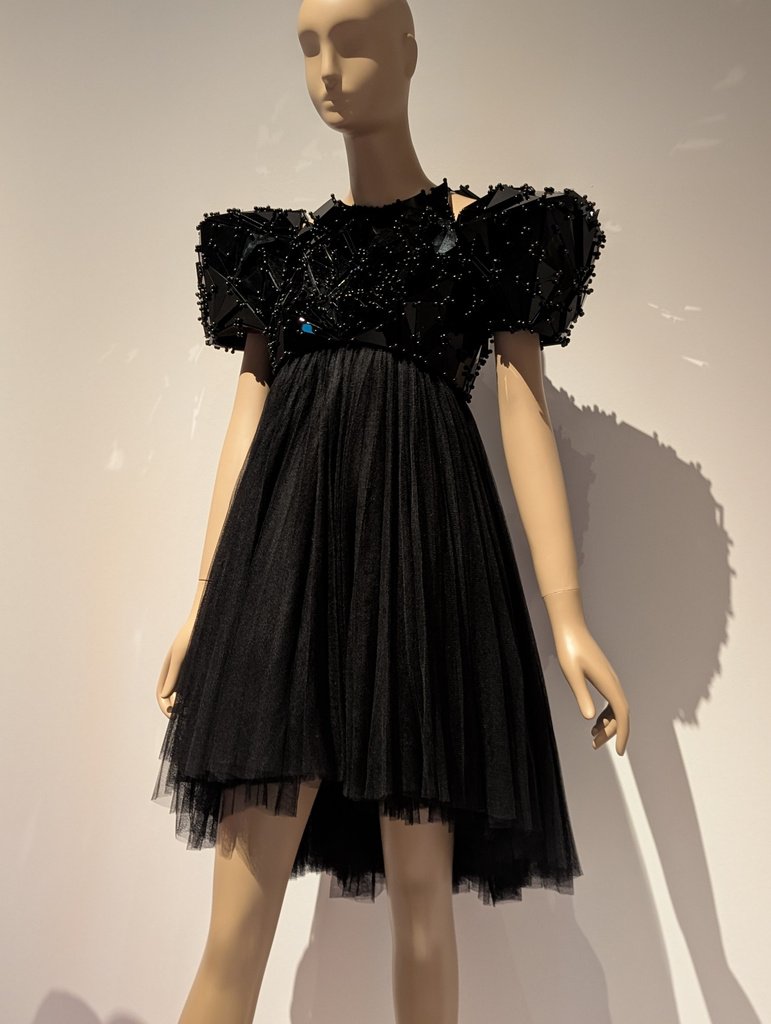
Black silk, tulle and acrylic dress, spring 2015 Dollhouse couture collection
MFIT, gift of Dice Kayek
From Punk Rock to the Kinderwhore Aesthetic
The exhibition seamlessly shifts from surrealist couture to 1990s alt-rock culture, where the broken doll became a powerful subversion of passive femininity.
Babes in Toyland: The cover of their debut album Spanking Machine (1990) places the band among worn, discarded dolls. Their subsequent album covers for Fontanelle (1992) and Painkillers (1993) featured surreal doll compositions photographed by Cindy Sherman.
Hole & Courtney Love: On the Doll Parts single cover (1995), a bridal doll dress lies pristine in a box. However, Courtney Love’s stage persona actively dismantled this “neat packaging”, pairing lace, nightgowns, smeared lipstick, and messy hair to create a look both fragile and combative.
Courtney Love’s 1992 Wedding Dress: An embroidered vintage nightgown worn on stage, rejecting traditional bridal perfection in favor of a lived-in, defiant history.
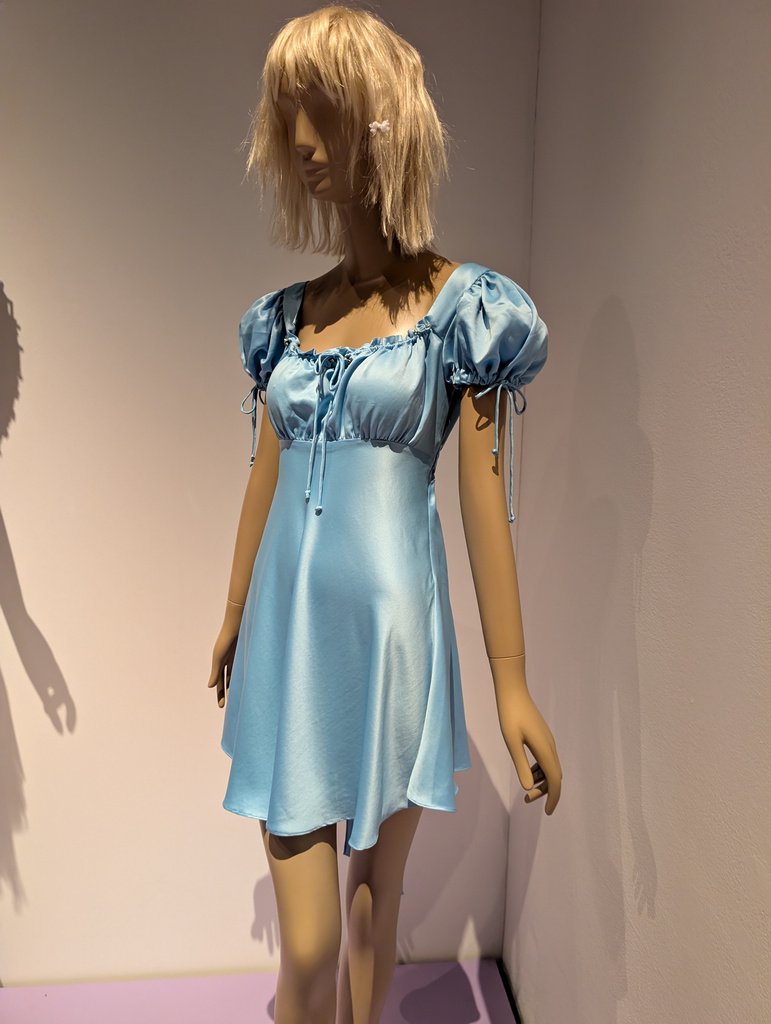
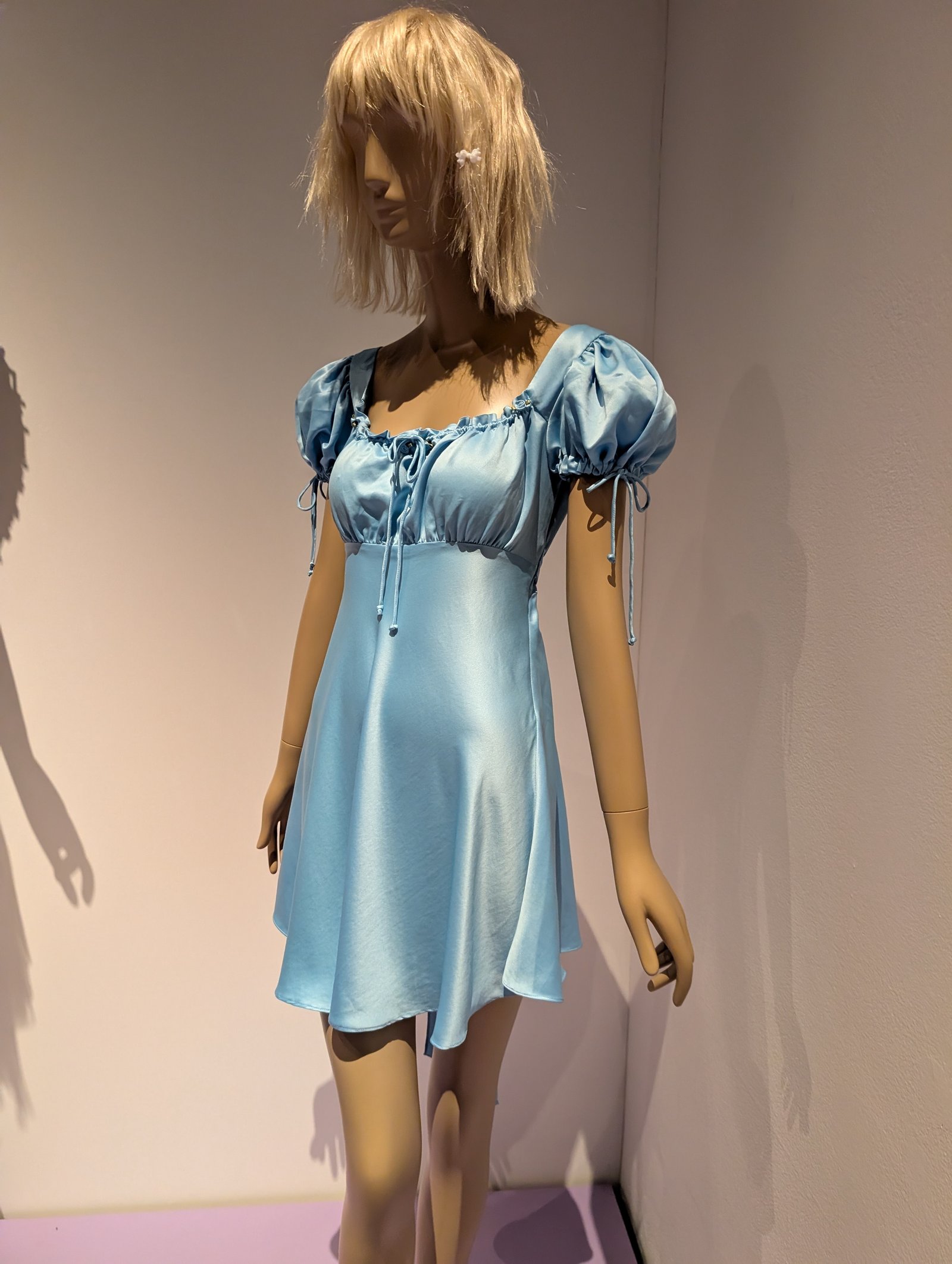
Pale blue satin baby doll dress, 2016 MFIT, museum purchase
The term Kinderwhore defines a deliberately confrontational 1990s style: babydoll dresses paired with heavy combat boots, smeared makeup, disheveled hair, and raw punk energy.
In 1992, the British music paper Melody Maker asked Donita Sparks from the band L7 for her opinion on the most original idea of the year. “Wearing little antique dresses (we like to call it ‘Kinderwhore’),” she responded.
While Sparks herself was not known for the look, her peers—especially Kat Bjelland, KatieJane Garside, and Courtney Love—made it legendary. Tattered vintage dresses, unkempt bleached hair, and smudged makeup characterized the Kinderwhore aesthetic, which deftly combined conventional beauty with deliberate irreverence. Their broken doll appearance was augmented by their use of dolls in promotional photographs, album covers, music videos, and song lyrics. These self-fashioned living dolls appeared broken and fragile, but they fully controlled their image.
The theme was further explored by:
- Kat Bjelland (Babes in Toyland), whose Bruise Violet video (1992) plays with blonde doll lookalikes.
- KatieJane Garside (Daisy Chainsaw), who turned her doll-like persona into raw performance art: “I was a puppet and the one pulling the strings.”
- Meadham Kirchhoff (Spring 2012): Designers Edward Meadham and Benjamin Kirchhoff sent a fleet of Courtney Love lookalikes down the runway to Hole’s Miss World, mythologizing the 1990s aesthetic for the catwalk.
The Power of the Imperfect Doll
From Bellmer and Kawakubo to Dice Kayek couture and Courtney Love’s rock rebellion, the broken doll proves that dolls in culture are far from innocent. They can be eerie, damaged, angry, or entirely uncontrollable, offering a fearless language to address body autonomy, trauma, protection, and dissent.
Sources & Further Reading
- Hill, Colleen. Doll Dressing. New York: Rizzoli Electa, 2026. (Official exhibition catalogue published in conjunction with The Museum at FIT).
- Bellmer, Hans. Les Jeux de la poupée. Paris: Éditions premières, 1949.
- Kawakubo, Rei. Body Meets Dress, Dress Meets Body. Comme des Garçons Spring/Summer 1997 Exhibition Notes.
- Love, Courtney. Dirty Blonde: The Diaries of Courtney Love. New York: Simon & Schuster, 2006.
- Sherman, Cindy. Cindy Sherman: Retrospective. New York: The Museum of Modern Art, 2012.
- The Museum at FIT. “The Broken Doll” Gallery Notes & Objects Registry, Fall 2026.